

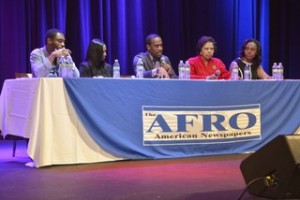
Panelists Dante Barry, Seema Sadanandan, Jeff Johnson, Dr. E. Faye Williams, and Allyson Carpenter at the AFRO Newspaper’s “Black Lives Matter” Town Hall meeting at the Howard Theatre. (Photo by Rob Roberts )
In its first Black History Month event, the Afro-American Newspapers hosted a community discussion on the commonly referenced epithet, “Black Lives Matter.” The town hall meeting took place on Feb. 10 at The Howard Theatre in Northwest D.C.
“I can’t tell you how I felt,” said panelist Jeff Johnson, an award-winning journalist and communications specialist. “It wasn’t like a date toremember like JFK’s assassination or the Challenger . . . there’s an inhumanity of Black lives by certain groups in this country.”
Other panelists included Allyson Carpenter, advisory neighborhood commissioner for Ward 1 and Howard University student; Dr. E. Faye Williams, president and CEO for the National Congress of Black Women; Dante Barry, executive director for Million Hoodies Movement for Justice; and Seema Sadanandan, program director for the American Civil Liberties Union. April Yvonne Garrett, AYG List speaker and facilitator moderated the event, and Radio One News and Community Affairs Director Ebony McMorris was the emcee.
Johnson said body cameras were not enough to correct the situation. Previous records should be investigated on negative recycled officers, and those hired as policemen coming from recent wars need to be checked in order to prevent these types of shootings, he said.
Williams emphasized that the youth should be told that conditions that plague today’s society are not their fault. “Teach them the difference between riot and revolution,” she said. “Teach young men to respect young women.”
Carpenter said she and others went to Ferguson, Mo. because of the killings. While there, she recalled meeting a group called “Lost Voices,” pegged as rioters. “We need an elevator; not criticism. Someone who is willing to invest in us,” she said.
Amongst typical addresses of frustration and anger from the audience, a solemn testament was given by a Maryland resident who lost her son, Emmanuel Okutuga, when he was fatally shot by a Montgomery County policeman outside a Silver Spring mall in 2011.
“When I heard it , it brought back bad memories. I found it difficult to swallow,” Olubunmi Comfort Oludipe said, holding a poster of her deceased son.
“My case was thrown out due to lack of evidence,” she said. “I feel for this mother. It’s worse when you bury a child just because of the color of their skin.”
Other issues discussed were police attitudes toward the Black community, community policing, youth involvement, shifts in leadership, local elections, and intergenerational relations. The imbalance in the criminal justice system was mentioned. According to recent data on African Americans in the District, there were 45,000 arrests made with 96 percent of them classified as non-violent.
According to an audience member, “We need cop watchers. We have had them in New York. It is important to train community members.”
There were also implications that, although Whites use top-tier drugs such as cocaine more, 91 percent of drug arrests were of Blacks.
Sadanandan said traffic stops, stop and frisk, and jump outs were common in the area. “There is a pattern of over-policing in D.C.,” she said.
The audience asked questions on how the media’s language equates negative behavior on Blacks, methods needed for youth in dealing with police, and communicating with elders in centralized situations for intergenerational partnerships. But the last question by 13-year-old Joshua Perry of Buck Lodge Middle School in Adelphi, Md. may have had the most impact. “How do you talk to your fellow peers who are ignorant and they want to make jokes about it?” he asked.
Perry shared an incident from school, when his teacher told a student wearing a hoodie to take it off. The boy ignored the teacher, jumped up and ran around the classroom yelling repeatedly, “I am Trayvon Martin! I am Trayvon Martin!”
Perry said the student was asked what he knew about Martin, but he could not give an answer.
Barry told Perry that it was probably too difficult for youth his age to understand what actually happened and the events that took place about Martin. “Just remember, your life matters,” Barry told him.
LaTrina Antoine, Washington D.C. Editor contributed to this story.
