


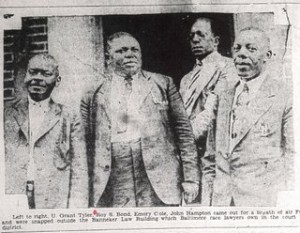
1928 • U. Grant Tyler, Roy S. Bond, Emory Cole and John Hampton outside the Banneker Law Building, which was owned by African-American lawyers.
After half a century of practicing law in Maryland, by 1935, Black attorneys were still denied entrance into bar associations.
The two local groups at the time—the Maryland State Bar Association and the Bar Association of Baltimore City—offered professional comradery and mentorship opportunities to its members.
“It was a way of networking and formally passing down information,” University of Maryland law Professor Larry Gibson says. “Older lawyers, in a social setting, could share information with younger lawyers and mutually help each other.”
The doors to those professional organizations were closed to Baltimore’s Black lawyers, so they created their own brotherhood around a mission to uplift the race. They called it the Monumental City Bar Association.
The Early Years
References to the Monumental City Bar date back to 1917 although the group’s early work was “spasmodic,” according to an AFRO article that commemorated the organization’s 10th anniversary.
The association’s first leader was Cornelius C. Fitzgerald, an attorney who specialized in testamentary law and was considered an authority on wills.
It was not until 1921, when W. Ashbie Hawkins became president, that he “led into prominence with a new program of cooperation, legal supervision for race people and a fight on the ‘black laws’ of Maryland,” the AFRO article reads.
The members of the group met each month, held discussions and formed committees.
“They were a collective voice,” says Gibson.
Although the attorneys led their own practices—some representing civil organizations such as the local NAACP and the AFRO—they united on civil rights concerns, opposed discriminatory laws, and endorsed politicians.
Marshall’s Role
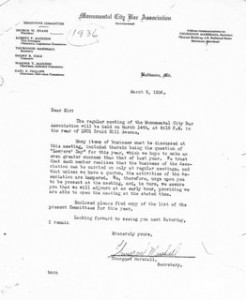
1936 • Monumental City Bar Association, regular meeting letter.
The Monumental City Bar was incorporated in April 1935. The group’s secretary was Thurgood Marshall, who would later become the nation’s first Black Supreme Court Justice. Gibson says Marshall drew up the legal group’s incorporation papers and filed them with the state.
When Marshall was a newly-minted member of the Maryland Bar in 1933, he was denied office space to start his law practice because of his race. He finally found a workplace with two members of the Monumental City Bar—Warner T. McGuinn and William Alfred Carroll Hughes Jr. They leased the sixth floor of the old Phoenix Building in downtown Baltimore.
“They were the first Black lawyers below Fayette Street,” says Gibson. “Most of the other Black lawyers were in the Banneker building on 14 East Pleasant Street, which is still occupied by Black lawyers.”
Marshall’s first big civil rights win came the same year the Monumental City Bar was founded. The case forced the University of Maryland’s law school to admit applicant Donald Gains Murray and thus all qualified Black students.
“Marshall felt strongly about this case because of his dismay, when he was about to begin his own legal studies, that he could not attend the Maryland school,” according to an AFRO article chronicling Marshall’s life in 1960.
His work with the University of Maryland set the stage for his most memorable case, Brown v. Board of Education, which led to the desegregation of all public schools.
The Black Legal Body
Serving as the “legal body” for the Black community, the members of the Monumental City Bar adopted resolutions regarding legislation, even sending telegrams to lawmakers urging their support of bills that were important to the race such as the anti-lynching bill.
In 1935, more than 22 cities on the East Coast had Black lawyers in their respective state’s attorney’s offices, but Maryland’s J. Bernard Wells told the AFRO: “I am afraid that Maryland is not ready for the appointment of a colored man .” Monumental City Bar members reacted by submitting petitions for the state’s attorney to appoint Black lawyers.
Members were also active in the National Bar Association, comprised of Black attorneys from across the country. Marshall served as secretary in 1937, and the Monumental City Bar often hosted NBA conferences.
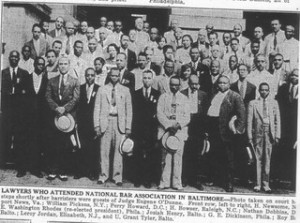
1934 • Lawyers attend the National Bar Association in Baltimore.
Prominent Members
Former Monumental City Bar president, E. Everett Lane, was the “first robed judge south of the Mason Dixon line,” according to an AFRO article. Lane was appointed by Maryland Governor Theodore McKeldin in 1957 as associate judge of what was then the People’s Court of Baltimore City—a local court that handled 19,000 cases annually. That same year, Lane was among the first three Blacks admitted to Baltimore’s bar association. He was also a veteran, having enlisted in World War I and having been honorably discharged as an army sergeant.
Lane called his work on the People’s Court “fascinating, but challenging…For the rights and welfare of many people must be guarded, and there are many cases in which those involved are unable, financially to procure counsel,” according to a speech referenced in a 1957 AFRO article.
Law was an integral part of the attorney’s family. His father was one of the first Blacks allowed to practice in Maryland, and Lane says he was named after Maryland’s first Black lawyer, Everett Waring.
A brother pair with ties to the legal group also contributed during this time period. The Kogers are said to have opened the first law firm in the country owned by Black brothers. Linwood G. and Azzie B. Koger were veterans who graduated from Howard University’s law school.

Roy S. Bond was credited with more divorces than any lawyer outside Reno.
Despite their similar interests in increasing opportunities for Black people, the pair had distinct strengths. Azzie B. Koger was more scholarly, writing about the history of Black lawyers and ministers. His brother Linwood Koger was more active as a lawyer, presiding over the Monumental City Bar for several terms, working as an assistant city solicitor, and heading the Baltimore Chapter of the NAACP. Linwood was also one of the first Blacks to run for the state legislature and Congress. The well-known attorney also became a judge and made an impression on a 13-year-old Gibson.
“He’s the first Black judge I ever saw in my life,” Gibson recalls. “I have the clearest recollection of going down to the Northwestern Police District…Seeing this Black judge up there, as far as I was concerned, he might as well have been on the Supreme Court.”
Another set of brothers opened a law firm in 1931—Cornelius C. and William L. Fitzgerald. The two-office firm specialized in real estate, fire, and automobile insurance. The elder brother, Cornelius, was Monumental City Bar’s first leader. The former city councilman and president of the board of trustees for Provident Hospital died of an illness in 1935, just months after the group’s incorporation.
William Fitzgerald’s legal career spanned more than 60 years. He was also a Monumental City Bar president, and he represented Baltimore’s 17th Ward on the city council from 1919-1923. An AFRO article in 1950 announced he was the first Black person to pass Maryland’s written law exam.
The younger Fitzgerald brother was a powerful voice behind the years-long campaign to increase Black teachers’ salaries. He was also a powerhouse real estate attorney, and the Housing Authority often called on him for help planning sites for low rent housing. His goal was to “make homes and investment property on principal streets available to members of his race,” according to his 1961 eulogy in the AFRO.
Another active member of the Monumental City Bar, Roy S. Bond, owned one of the largest divorce practices on the East Coast. An AFRO article credited him with more divorces than any attorney outside Reno.
“A White lawyer told me lines would come out of the building to see Roy Bond,” says Gibson. “He was handing out more than one divorce decree in the same day. The highest I found he issued was 12 .”
Bond served four terms as president of the Monumental City Bar, often mentoring up-and-coming attorneys and letting them take over some of his divorce cases.
Although many of Maryland’s first Black lawyers championed civil rights cases, “they had to make a living,” explains Gibson. “Bread and butter work for lawyers was divorces.”
By the 1950’s, the coalition of Black attorneys started winning local and state appointments, but it would be over the next two decades that they truly began to play a prominent role in the state and country’s political scene.