

Baltimore has seen nine more homicides to date than it did last year, but residents throughout the city say they have not noticed the increase. This suggests the violence which plagues the city has become so entrenched as to be unremarkable.
As of April 13, Baltimore had seen 57 homicides. Mayor Stephanie Rawlings-Blake has argued that recent increases in the number of homicides reflect seasonal trends in crime that occur as the weather warms, though her administration remains undeterred in its efforts to reduce violent crime.
“I’m focused like a laser on making our city safer,” said Rawlings-Blake during brief remarks to the press on April 7. “We’ve made a lot of progress and I’m not going to let this setback or any one in the future deter us from having the safer city that I know Baltimore can be.”
But residents who spoke to the AFRO about the violence in Baltimore City seem to diverge from the mayor where solutions to the violence are concerned. At the April 7 press conference, the mayor said that outside the box thinking is essential to reducing the city’s violent crime figures, but almost everyone who spoke to the AFRO argued that the violence in the city has a simple solution: jobs.
Indeed, of the 10 people in three different neighborhoods who spoke about their reactions to the increased level of violence in the city, not one said they had noticed any changes beyond what they had come to expect. However, when asked what could be done to reduce the violence, the refrain of jobs was almost universal.
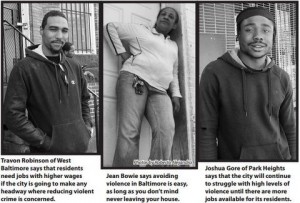
“If more jobs for most of the Black people in every in Baltimore, you might cut down on the crime, drug selling, and a lot of stuff,” said 20-year-old Park Heights resident Joshua Gore. “Because without a job, a guy’s gotta come out here and sell drugs all day.”
Gore says he knows of people who have found work but have nonetheless had to resort to dealing drugs because the wages do not allow them to meet their needs, an assessment that Travon Robinson agreed with. “The average person looking for a job, or living in poverty and searching for a job, when they get a job they struggle to get to the job. So, by the time they get paid, their first paycheck is going back towards what? Their ride. Their bills. So it’s like, ‘yeah, I’m working, but I’m seeing no progress.’ And minimum wage, you can’t survive off that . . . you can’t do it. It’s not happening,” said Robinson.
The city needs to do a better job of promoting its job training programs, according to Robinson. “Make it a program that actually applies to the area,” said Robinson. “If you’re teaching these people computer technology, but there are no computer technology jobs in their area, that doesn’t even make sense. Government officials need to get common sense.”
For Jaylan Johnson, 19, the lack of jobs is made worse by a law enforcement focus skewed towards low level drug offenses rather than violent offenders. “There’s a lot of young out here that are trying to hustle because they can’t get no jobs even if they’ve got a diploma,” said Johnson. “Then they try to lock us up for trying to sell weed, but you aren’t locking people up that are shooting. are scared of them, but they are quick to grab us up though.”
Johnson said certain policies of the state exacerbate the problem. He had been enrolled in a trade certification program while serving a probation sentence, but had to leave the program when he finished probation early. At that point, he said, the state stopped subsidizing his participation, leaving him with a $5,000 a month fee he had no way of affording and forcing him to drop out.
In the meantime, a number of residents say they have a simple way of navigating the violence that has become the norm in Baltimore City. “I don’t come outside,” said Patricia Banks at a hair care supply store in Park Heights. “When it gets warm more stuff happens.”
ralejandro@afro.com
