


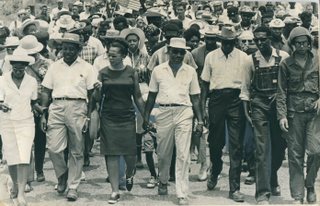
March 1965 – Dr. Martin Luther King Jr. and wife, Coretta, center, lead marchers from Selma to Montgomery in protest against racial discrimination in Alabama.
Living for justice even in the face of imminent death is Martin Luther King Jr.’s enduring legacy and example, say a number of Baltimore’s prominent civil rights elders. This year will mark the 50th anniversary of King’s famous march from Selma to Montgomery, Ala., and the Voting Rights Act (VRA) it helped spur into law. But these elders, who started their activism in the ’60s and have continued the fight since, say more must be done to take advantage of the franchise so many gave their lives to earn.
Leo Burroughs, chairperson of the Community of Concerned Citizens in Baltimore City, was a member of the Baltimore chapter of the Student Non-violent Coordinating Committee when the civil rights organization had its regional meeting in Baltimore in April 1964.
“What I was most impressed about Dr. King . . . I was impressed with his sense of humor. Aside from the fact that he was brilliant and committed, and a brilliant orator – because he spoke that day at that conference – was the fact that he was a regular guy, down to earth, and really a lot of fun. . . . But again, the man sacrificed his life, as have others, in the fight for justice and liberation in America,” Burroughs said.
Ronald Flamer, 2nd vice president for the Baltimore City NAACP, was a student at Morgan State University from 1961 to 1965 and active in the city’s desegregation efforts. “Every Saturday I would go out on a freedom march, or a demonstration, to integrate a number of restaurants, and different department stores here in Baltimore,” Flamer said.
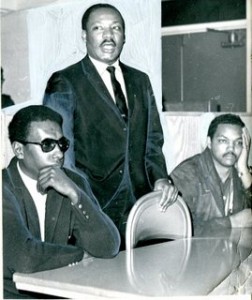
Stokley Carmichael, Dr. King and Jesse Jackson.
Flamer called King “the Moses of our people,” and recalled attending the meeting Burroughs mentioned, which Flamer says was held at Cornerstone Baptist Church, where the Rev. Logan I. Kearse, who had studied with King in seminary, was pastor.
“One of the speakers, before Martin Luther King arrived, said that the Baltimore City police had just announced that a bomb was in the church, and I remember nobody left,” said Flamer, of the crowd’s resolve not to be cowed by threats of violence. “They said, ‘we’ll blow up in the name, the cause of freedom.’”
For Flamer, “there will never be another Martin Luther King. He was my hero.”
Burroughs recalls King with similar warmth. “I have nothing but accolades and adulation for the Rev. Dr. Martin Luther King Jr. What a marvelously dedicated man to have risked his life and that of his children, his family to fight and to struggle in the way that he was struggling. I have nothing but admiration for a man who would, as a tactic and strategy, engage in civil disobedience, and go to jail, and do those things,” said Burroughs.
When asked what he thought King’s greatest legacy was, Dr. Marvin Cheatham, former president of the Baltimore City NAACP and current president of the Matthew A. Henson Neighborhood Association, said, “Knowing that he was giving his life to help others.”
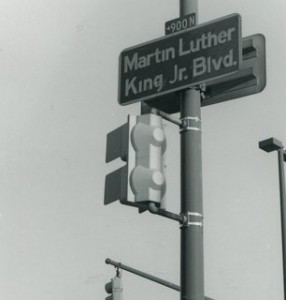
Dr. King is commemorated in many cities by streets named for him.
“I think not only did he do it, but it was clear that he knew that his days were numbered,” Cheatham continued. “But he still saw fit to give his life and speak truth to power, to challenge people to do better, and be willing to lose his life and to lose his health because he was fighting for others. I think that’s a legacy that money can’t buy. He gave his life, and knew he was losing his life, because of it. He lost his family and everything as a result of it.”
Cheatham also shared his thoughts on the significance of the VRA, which was signed into law in 1965 by President Lyndon Johnson, recalling that, prior to passage of the federal law, Baltimore City had many ordinances controlling where African Americans could and could not live. “Voting rights was important because we needed representation to fight these ordinances,” said Cheatham.
Cheatham added that younger adults today do not appreciate the importance of the franchise, which is driving his current effort to bring the total number of registered voters in Baltimore City back to 400,000 people. “It’s an injustice that we’re perpetrating on our foremothers and forefathers that we don’t understand the importance of voting rights,” said Cheatham.
Tessa Hill-Aston, president of the Baltimore City NAACP, said King’s greatest legacies were standing firm, and his gift for oration. Hill-Aston agrees with Cheatham that folks must take greater care of their right to vote.
“Right now we have people that won’t go two or three blocks in their nice cars, or come out of their house and walk a block to where they could vote, so we have a problem because if people who can vote, and don’t vote – and Martin Luther King went through all this so that we all could vote . . . and those people in Selma could walk across that bridge and go do what they did, there’s no excuse for anybody not to vote right now in this day and age,” said Hill-Aston.
Burroughs, who turns 73 in March, says that he thought the VRA would bring African Americans further than they have come so far, but remembers that King’s assassination in 1968 was a call that he continues to answer 50 years later. “I was very much in despair about that,” said Burroughs, “ that we had a charge and a responsibility to go forward and continue.”