

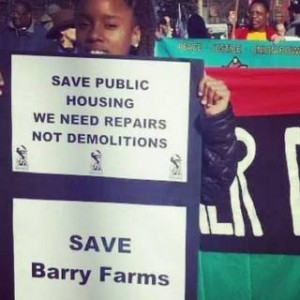
Residents of Barry Farm Dwellings march to keep their community. (Photo/Empower DC)
Paulette Matthews, 55, has been living in the same neighborhood in Southeast D.C. for the last 20 years, but is being told she will soon have to leave for 10 to 15 years as her neighborhood is torn down and rebuilt for new residents. This is a story all too familiar to residents of public housing.
Matthews lives in Barry Farm Dwellings, a public housing complex, where over 400 families live. The families who live there have been told since the 1990s that the property would be redeveloped and that they would have to leave at any point. The difference now, however, is that plans have been drawn up for what the property would look like and residents are being given the choice to leave.
“We all know that gentrification doesn’t happen overnight. It’s something that’s planned years in advance,” said Schyla Pondexter-Moore, organizer for the public housing campaign at Empower DC and member of the Barry Farm Tenants and Allies Association. “This is no way that people should live, having to think about at any time they would have to leave their homes, just because they’re low-income.”
The District plans to tear down the public housing and build 1500 units of mixed-income housing, with 360 replacement units for the current residents. Residents are inconvenienced, however, because these developments can take up to 15 years. During that time, residents are moved to other public housing, which could affect the residents’ jobs and families.
“My mom is able to get to work because there are transportation services at the Anacostia Metro,” said Detrice Belt, resident and president of Barry Farm Tenants and Allies Association. “It isn’t offered at other metro stations, so how is she supposed to get to work if she’s moved? People have jobs, people have kids. This is a community and the city is telling people that they have to leave.”
This is the same situation for many of the public housing complexes in D.C. Most of the time, residents are not able to move back into their communities as it is a long time-span and there are requirements that residents have to meet in order to move back. Usually, residents are unable meet the requirements to move back, such as credit and background checks. While the return criteria for Barry Farm residents has not been published, Ari Theresa, attorney for the Barry Farm Tenants and Allies Association, said often residents of public housing are not able to come back.
“Theoretically, in 10 plus years, everyone is supposed to be able to come back, but the way that it has worked in the past, they don’t. They don’t provide the replacement units,” Theresa said. “They say that they will provide 330 units and they only deliver 100 or 50 or 20, and that’s the way that the new communities have worked in the past. I just want to make sure that the residents of Barry Farm have the best outcome and are treated with respect.”
Robyn Fields knows this experience all too well as she was displaced from Capers public housing and went through a 10 year process to be able to move back. After having to move between different public housing and having to tell her daughter to leave because the income between the two of them would not allow for her to move back, Fields was finally able to move back into a neighborhood that she once called home. However, she now feels foreign in a place that used to be her community.
“I had to go through a hurdle of loopholes, go through credit checks and everything. Now, I’ve seen about 12 of us here, out of 90,” Fields said. “They act like they don’t want us here, when y’all invaded our space.”
Members of the Barry Farm Tenants and Allies Association have come up with alternate solutions, but the city has repeatedly responded saying that displacement is the only way. One solution would be to not have demolition at all and have the money go towards meaningful repairs and programs to enhance the area. Another solution, with more of a compromise, would be to renovate the complex, street by street, and move residents to other areas of the complex while their street is being repaired. The city has said that construction without moving the residents would not be safe, even though a recreation center on the site was recently repaired with the residents living on site, along with the construction of the Homeland Security Building.
“It’s disgusting, because at the end of the day, they’re not thinking about human lives or how they are affecting them,” said Matthews, who lives in Barry Farm with her son and grandson. “They’re just worried about the money.”
The goal of the Barry Farm Tenants and Allies Association is to make sure residents are treated with respect. There will be a citywide forum from 2 p.m. to 5 p.m. Feb. 22 at the Anacostia Library. Childcare and transportation will be provided if needed. “Most people know that it’s coming down and we want people to know the details of everything,” Moore said. “We need to be concerned about the poor in D.C. The poor are not invisible, we are people.”
For more information about the forum, visit empowerdc.org or contact Schyla Pondexter-Moore at (202) 234 – 9119, extension 101.
