

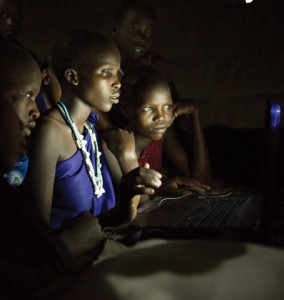
For hundreds of millions of Africans, 2015 remains a dark age and sunset signals hours of darkness and hours of lost study time, stifled industry and even poorer health services, as medicines cannot be refrigerated.
A bipartisan group of U.S. senators led by Maryland Democrat Benjamin Cardin are hoping to bring 50 million of those Africans into the light, and thereby boost socioeconomic outcomes, by bringing electricity to their homes for the first time.
On Aug. 4, Cardin, ranking member of the Senate Foreign Relations Committee, and Chairman Bob Corker (R-Tenn.) reintroduced the Electrify Africa Act, which would leverage public and private sector resources to bump electricity generation capacity by 20,000 megawatts by 2020 and extend power to previously unlit homes.
“Access to electricity remains one of the fundamental development challenges in Africa, with direct impacts on public health, education, and economic growth,” Sen. Cardin said in a statement. “That’s why this bipartisan legislation draws upon American leadership and ingenuity to provide first-time electricity access to 50 million Africans by developing clean, affordable, and sustainable energy. By working with African governments to attract private sector investment and partnering with American firms that are on the cutting edge of the power solutions Africa seeks, we can make great strides in addressing African energy poverty and promote economic growth at home and abroad.”
According to the World Bank, sub-Saharan African is plagued by low access to electricity. Only 24 percent of its population has access to power versus 40 percent in other low-income countries. Another problem is insufficient electrical capacity—without counting South Africa, the sub-Saharan’s electrical grid equals only 28 gigawatts, equivalent to that of Argentina.
Other problems impacting the region’s energy are the considerably high number of power outages and high tariffs.
But solutions have been difficult to effect as funding has been insufficient—public assistance and private investment each has averaged only around $600 million per year and expanding electricity access would require much higher levels of financing, the World Bank estimated.
The Electrify Africa Act would, among other things, require the president to create a comprehensive strategy delineating the United States’ approach for addressing the energy needs in Africa.
The legislation also urges prioritization of private investments in projects meant to boost access to and reliability of electricity in sub-Saharan Africa by quasi- and non-governmental organizations such as the Overseas Private Investment Corp., USAID, the U.S. Department of Treasury, World Bank, U.S. Trade and Development Agency, and African Development Bank.
The legislation mirrors efforts such as “Akon Lighting Africa,” brainchild of philanthropist, business mogul and five-time Grammy nominated artist Akon, who joined with GIVE1 PROJECT and Solektra International to create private-public partnerships to encourage installation of solar power equipment in African households, among other solutions.
ONE Campaign, a global anti-poverty effort, has endorsed Cardin’s legislation.
Sharon Rudge, a Baltimore-based member of the ONE Campaign and the executive director of Kenya Connect, praised Cardin for taking leadership on the issue.
“We take for granted that our homes, our schools, and our hospitals here in Maryland have access to the electricity they need to operate, but energy poverty is a destructive force on the African continent,” Rudge said in a statement. “By helping Africans build and expand their electricity infrastructure, the United States can make huge strides in the fight against extreme poverty.”
