

This is the second in a series of articles about laws that have significantly impacted Black women in America.

Despite advancements in the workplace, Black women continue to suffer from job inequality.
In the history of laws that have significantly impacted the lives of African Americans, the Civil Rights Act of 1964 is among the premier league.
“ was pivotal. It was probably the most game-changing legislation for Blacks in the United States,” said Barbara Arnwine, executive director, Lawyers’ Committee for Civil Rights Under Law.
And Title VII of that law, which barred workplace discrimination on a number of protected categories was particularly beneficial for African-American women, historians and activists agree.
“Title VII has been absolutely radical for Black women,” Arnwine added. “By barring discrimination on the basis of race and gender it cleared the way for African-American women to fully participate in the workplace. Before that we didn’t see women employed across all sectors.”
Black women and labor have been closely intertwined since the first 19 African slaves were dumped on the shores of Jamestown, Va., in 1619. Blacks were seen as a source of cheaper, more plentiful labor than indentured servants (usually poor Europeans), and formed the economic backbone of the American South, which specialized in the production of crops such as tobacco and later, cotton.
Even after Emancipation, freed Black women were expected to work—unlike their White counterparts who society put on a pedestal. According to a working paper by the National Bureau of Economic Research, from 1870 to 1900, the labor force participation rate of Black women was about 40 percent compared to less than 15 percent among White women.
The Freedmen’s Bureau, a federal agency that was supposed to assist former slaves in the South, often acted as an agent in trying to force Black women to work, either by having husbands contract their entire families to work in the cotton industries or by declaring that unemployed women would be treated as vagrants just like men.
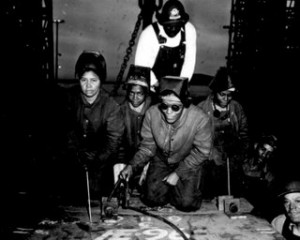
Welders Alivia Scott, Hattie Carpenter, and Flossie Burtos await an opportunity to weld their first piece of steel on the ship SS George Washington Carver at Kaiser Shipyards in Richmond, Calif. Ca. 1943. (E.F. Joseph/ National Archives)
Overall, however, it was almost impossible for former slaves to make any advancements in the post-Civil War economy in the South thanks to restrictive Black codes and systems of involuntary or forced labor, such as peonage, debt bondage and apprenticeship and regressive contractual arrangements such as sharecropping.
The lack of opportunities led millions of slaves to migrate, lured by promises of a better life in the industrial centers of the North. But conditions were deplorable, and Black women had to compete for menial, usually domestic, jobs.
The advent of World War II presented the greatest challenge to White male domination of primary sector jobs and the greatest opportunity for job advancement for Black women up to that point in U.S. history.
“Although scholars have given some attention to the labor-force fortunes of blacks in the war economy, few have considered the impact of the war-time expansion on black women, who constituted 600,000 of the 1,000,000 blacks who entered paid employment during the war years,” wrote Karen Tucker Anderson in the article “Last Hired, First Fired: Black Women Workers During World War II,” which was published in the Journal of American History.
As more men were mobilized to fight the war abroad, women were recruited to work in wartime industries—building airplanes, making ammunition, working in shipyards, among other duties. For Black women, who had been relegated to the lowest-paying domestic and farm work, war opened job categories and fostered upward mobility, wrote Anderson, citing scholars such as William Chafe, who “contends that the opportunities generated by the war-time economy and the long-term changes they fostered constituted a ‘second emancipation’ for black women.”
But historian Ruth Milkman in Gender at Work: The Dynamics of Job Segregation by Sex During World War II contends that while wartime mobilization swept aside the traditional sexual division of labor, after the war, women “were forced back into traditionally female occupations, or out of the labor market altogether.”
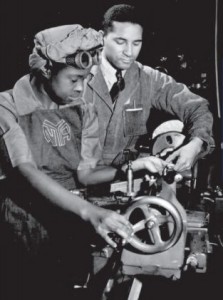
World War II opened up job opportunities for Black women. In this image, under the direction of National Youth Administration foreman Cecil M. Coles, Juanita E. Gray learns to operate a lathe machine at the Washington, D.C., NYA War Production and Training Center. This former domestic worker is one of hundreds of Negro women trained at this center. (Roger Smith/National Archives)
The relegation of women to “pink-collar” jobs and discrimination against women in the workplace persisted, and was particularly injurious to Black women, who were often on the lowest economic rung and served as primary or co-primary breadwinners for their households.
“They needed to have jobs where they were not just relegated to the kitchen,” Arnwine said.
But such discrimination was not robustly addressed until the Civil Rights Act and Section VII was passed.
“With laws on the books it provided an avenue for women to bring claims in court or before the Equal Employment Opportunity Commission for redress and that opened up more jobs and workplaces for women,” said Lenora Lapidus, director of the Women’s Rights Project at the American Civil Liberties Union.
The first Supreme Court case addressing gender discrimination on the basis of Title VII was {Phillips v. Martin Marietta} in which the NAACP Legal Defense and Education Fund represented the plaintiff, Ida Phillips.
According to the record, Phillips, a White woman from Florida, applied for the position of assembly trainee at the Martin Marietta Corp. after reading a classified ad. Shortly thereafter, she was informed the company was not accepting female applicants with preschool-age children. When she learned men with preschool-age children were being considered, however, Phillips decided to file a complaint.
In January 1971, the Supreme Court ruled in her favor.
“By adding the prohibition against job discrimination based on sex to the 1964 Civil Rights Act Congress intended to prevent employers from refusing ‘to hire an individual based on stereotyped characterizations of the sexes.’ … Even characterizations of the proper domestic roles of the sexes were not to serve as predicates for restricting employment opportunity,” wrote U.S. Justice Thurgood Marshall in his concurring opinion.
“It began the process of making employers understand that they could not rely on stereotypes about women and the role of women to keep them from entering the job market,” said Sherrilyn Ifill, LDF’s current president and director-counsel.
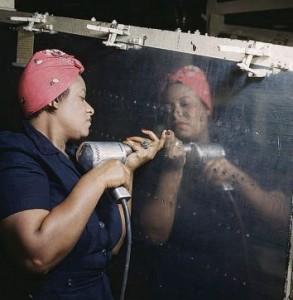
A Black woman is seen operating a hand drill at Vultee Nashville, where she is working on a “Vengeance” dive bomber in Tennessee, in February 1943. (Photo by Alfred Palmer/Library of Congress)
“People think about us as only fighting race discrimination, but we recognized the importance of seeking equality as a whole,” Ifill added. “The idea of women being able to operate equally in the workplace is as important as any other civil right women can have. Women play a vital role in every aspect of our society and barring women from participating fully in the workplace not only discriminated against women, but also impoverished the workplace from the contributions women could make.”
According to Arnwine, Title VII “spawned a whole generation of laws in the states” addressing issues of workplace discrimination and federal laws such as the Pregnancy Discrimination Act of 1978 and the Lily Ledbetter Fair Pay Act of 2009, which extends the time in which workers who learn of a pay disparity can bring a lawsuit against their employers.
Despite the progress ignited by Title VII, workplace discrimination remains.
“Many people believe that sexism in the workplace is a thing of the past, but evidence suggests that is alive and well,” Michael Schmitt, a former expert in workplace discrimination at Purdue University said in a psychological study. “Women get paid less than men, are less likely to be hired or promoted, do more unpaid domestic labor and are highly underrepresented in positions of power.
“A number of psychological investigations suggest that both women and men underestimate the degree of sexism against women. People want to think they live in a fair world in which men and women can do anything they want, regardless of gender,” he added.
Such challenges are especially acute for African-American women, who often walk the double gauntlet of race and sex discrimination in the workplace.
“There have been attempts by women of color to bring cases of intersectional bias but the courts have had a hard time dealing with that,” Lapidus said. “They’ve wanted to deal with cases on the basis of either race discrimination or gender discrimination but not both.”
And stereotypes persist, barring women from jobs such as law enforcement, firefighting and construction.
“There is still a lot of gender stereotypes out there about what kind of work women can do, or the idea that women only work for ‘pin money’ but they are not the primary wage earners, when in reality, in 41 percent of families with children, woman are the primary or co-primary wage earners,” Lapidus said.
There are also persistent issues related to the accommodation of female workers, Arnwine said.
“We are still way behind most Western nations in providing for women employees, to give them the time off they need to care for loved ones and offering benefits such as child care. Childcare is so expensive that it drives poorer women out of the workplace.”
Lack of accommodation is especially acute for pregnant workers, Lapidus said. The ACLU currently has pending cases, including Young v. UPS, which the Supreme Court is scheduled to review, which challenges the employer’s unwillingness to offer light-duty accommodations to pregnant employees though it offers such accommodations to workers who were injured on the job and who are disabled.
The ACLU has also filed an amicus brief in Home Care Association of America v. Weil. The case challenges a federal judge’s decision to overturn Department of Labor rule changes in 2013 that would grant basis minimum wage protections to home health care workers, a field dominated by women of color.
The exclusion of domestic workers from the nation’s labor laws was both a legacy of gender stereotypes and of slavery and Jim Crow, Lapidus said.
“Stereotypes that do not value work that’s done in the home is really a legacy of slavery when enslaved African-American women were forced to work in the home and be caretakers. These jobs are just not treated as valuable,” she said.
Sex discrimination continues both at the lower echelons and the higher echelons of the labor market.
A 1995 report by Congress’ Glass Ceiling Commission found that despite an increasing presence in the workplace, women and minorities were barred by impenetrable barriers from entering the executive suite. At that time, the commission noted that only 3 to 5 percent of senior management positions in Fortune 500 companies were filled by women. It also found that women in senior positions often held positons in areas such as human resources or research which are not part of the usual pipeline to executive positions. Furthermore, the findings found disparities in compensation, which is a problem across the labor marketplace and the reason why advocates have been trying to pass the “Pay Fairness Act” in Congress.
“The pay gap continues to be a problem overall but it is particularly harsh for women of color,” the ACLU’s Lapidus said. “White women who work full time earn 78 cents for every dollar earned by a White man, but Black women earn 64 cents for every dollar earned by a White man and Hispanic women earn 56 cents.”
