


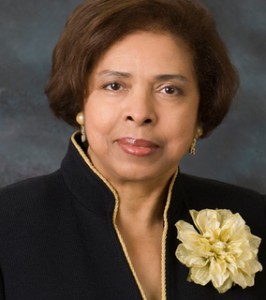
Dr. E. Faye Williams, Esq., President, National Congress of Black Women.
(Updated 5/23/2015) Currently, there is an ongoing case that is underway in the World Bank’s Administrative Tribunal involving an African litigant who wanted to introduce a DNA test result to establish that blacks are human and should be treated as such by the World Bank and its Administrative Tribunal.
The request may sound outlandish, or even blasphemous, but for the fact that it is the only legal option the aggrieved African is left with after the World Bank Tribunal ruled both in 2010 and 2014 that he cannot use medical certificates to establish emotional and psychological damages, but white claimants can. As Reverend Jackson noted in his recent open letter to Pope Francis, “The issue is not the validity or lack thereof of the medical reports under consideration. Rather, the issue is an inexplicable judicial practice of treating black and non-black complainants differently.”
A 1998, World Bank report revealed “a cultural prejudice among some managers, who rated Sub-Saharan Africans inferior.” In 2010 and 2014, the Tribunal, as an institution, exposed a judicial prejudice that treats Sub-Saharan Africans as physiologically and psychologically different, if not inferior.
As the above noted Reverend Jackson’s open letter noted, “The only black judge on the Tribunal’s panel sent the aggrieved staff a written apology, acknowledging that he did not agree with the Tribunal’s judgment but still voted with the other two judges because he ‘did not find it fit then to dissent.’ He ‘was not yet ready for such a momentous step’ of voting his conscience against the status quo.”
The judge is not a newly minted jurist to be “not yet ready.” According to the World Bank website, he is a professor of law at Columbia University with 50 years law practice. What he was not yet ready for was to go against the Bank’s de facto policy and long held practice of treating blacks as inferior (as explicitly acknowledged in several World Bank studies in 1992, 1998, and 2003).
On January 8, 2015, the Aggrieved African appealed to World Bank President, Dr. Jim Yong Kim, to weigh in. He wrote to the Korean American:
“I am contacting you not only as the President of the World Bank, but also as medical professional who is under Hippocratic oath . I have asked the Tribunal to give me extra time to file DNA test results along with a Doctor’s paper to help the judges understand that Blacks are human and suffer the same emotional and psychological damages that people of other races suffer when subjected to sustained psychological abuse. The DNA test results take at least six weeks. In the event that the Tribunal rejected my request for extra time, I would like to ask you to write an affidavit as a medical professional confirming that Blacks the same emotional and psychological damages like people of other races.”
The president ignored the appeal. This was followed by the Tribunal’s rejection of his request for extra time to file his DNA test results.
This is not an isolated incident, but a reflection of an endemic institutional culture of racism. As this writer noted before, a simple Google search will confirm the breathtaking racial injustice, producing several citations of articles with shocking titles that seem to describe another era or a faraway place. Frank Watkins, public policy director at Rainbow/PUSH Coalition had it right when he wrote: “To hear firsthand the harrowing discrimination that Black employees endure in the World Bank is to be transported back in time to the 1950s.”
The outrage is not limited to liberal civil rights advocates. Gregory Simpkins, a conservative and currently Staff Director for the GOP controlled U.S. House Subcommittee on Africa and Human Rights, blogged about the same case in a piece titled “Walking Apartheid Avenue”, nothing that the World Bank is using its immunity from lawsuits as a carte blanche for impunity. Mr. Simpkins wrote: “We may not be able to sue them in court for such blatant discrimination, but we are not without recourse. No agency that depends on funding should take that funding for granted.”
The Bank’s former Senior Advisor for Racial Equality is on the record acknowledging that the case represents the worst racial discrimination case that he has ever seen. A heavily edited and sanitized 2014 World Bank diversity and inclusion report that was prepared under the auspices of the Bank’s HR vice president found the case to be a “blatant and virulent” case of racism.
The US Treasury, the US Board of Director to the World Bank, the US Congressional Black Caucus, eight of America’s leading civil rights organizations, leaders of over 500 faith-based organizations, and the Government Accountability Project (GAP) intervened at different times to seek justice for the African, but President Kim chose to retreat behind the veil of the Bank’s immunity protection.
In a letters addressed to the former US Attorney General Eric Holder, the former Chair of the US Senate Appropriation Committee (Senator Barbara Mikulski) referred to the noted-case as a “very serious issue” and demanded that the Department of Justice (DOJ) “take every appropriate action to address this problem as soon as possible.” Mr. Holder responded regrettably that the DOJ has no jurisdiction over the World Bank.
As the criticism from the outside world mounted, President Kim lined up a few Africans including his Chief of Staff to defend the Bank. The Chief of Staff who hails from Ghana wrote to the DC Civil Rights Coalition: “We at the WBG take our commitment to diversity and inclusion very seriously. There is no place in our organization for discrimination of any kind. The picture being presented by some former staffers is not the vibrantly diverse WBG where I proudly work.”
Another African, who wears two hats as an HR manager and as a custodian of the African Society Affinity Group in the World Bank rejected the growing external uproar. He wrote: The criticisms leveled against the Bank “do not reflect the work conditions or the state of employee relations at the World Bank Group today. therefore does not see any need for outside intervention.”
In the meantime, the Bank’s 2014 diversity and inclusion report gave the Bank 2.5 on the scale of 6. This is equivalent to 42 percent on a scale of 100, or a solid “F”. The report highlighted that the World Bank is at a stage where it is, “tolerant of racial and cultural differences. However, it is not open to those who question the status quo.” As reported by six World Bank and Staff Association reports, the status quo is that Blacks are “rated inferior” (1998); Paid race-based salaries (1992, 1998, 1999 and 2003); and segregated or “ghettoized” (1998 2003, 2005 and 2009).
President Kim would be well advised to pay heed to the growing Black Lives Matter movement in the US. White collar racism is not exempted from public protest.