

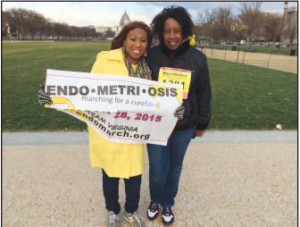
Chandelis Duster and her sister outside the Capitol (Photos by Jonathan Hunter)
Chandelis Duster, a graduate student at American University, stood before a packed crowd on March 28 at the Holiday Inn near Capitol Hill to share her endometriosis, commonly known as endo, story. “I remember being scared to death and feeling lost because I was told I had a disease that was not curable. But as I reflect on my experience, I think about how much stronger of a young woman I’ve become because of it,” Duster said while fighting back tears.
Duster words inspired the crowd at the second annual worldwide Endo March In D.C. Duster was just one of many women with Endo who came from all over the country to march on Capitol Hill to raise awareness about the disease.
In an exclusive interview with the AFRO, Duster spoke about raising awareness of the disease with African Americans. “I really just feel like Black women don’t have access to the right health care sometimes,” said Duster. “A lot of my Black friends I talk to , ‘Endo what, what’s that?’,’Is that what they call bad cramps.’ Nobody knows what it is. I had somebody tell me a long time ago that endometriosis was a White women’s disease. And I was like, ‘Excuse me ,what are you trying to say because I’m not White.’”
According to Pubmed.gov, the common view is that endo rarely affects women of color and results in many cases not being reported. Duster, now 26, was diagnosed with endo at age 18 and has had three surgeries to date. Duster says having endo has taken its toll on her physically.
“All throughout high school and middle school I would faint and pass out because my period pain was so bad, said Duster. “ I went to gynecologist to regulate my period and I remember specifically an emergency room doctor at one point told me that maybe there was an underlying trauma from your childhood that needs to be addressed to figure out what’s causing your pain.”
Once Duster was diagnosed with endo, she knew there needed to be something done to address the lack of knowledge about endo.
Duster is currently a precinct manger in Richmond, Va. for the World Wide Endo March organization. Along with being a precinct manger for a year, she has been an advocate for pushing legislation about educating the public.
Duster met with Virginia Lt. Gov. Ralph Northam at a disability caucus about endo and submitted a proclamation to Virginia Gov. Terry McAuliffe that he signed.
Duster says she enjoys being a precinct manager with team Virginia of the Endo March not only because she likes spreading awareness, but also because she has a family of sisters. Duster says she came to the Endo March last year in 2014, and met a support group of women that she was lacking.
“At first I thought these women were crazy, out here in all that yellow and wearing ribbons, but then I was like wow these are some of the nicest women I’ve met in my life. They gave me that extra push,” said Duster. “In a way Endo was a gift to me. Looking at it from a positive perspective because I’ve become so stronger and gained so many friendships and a sisterhood from having Endometriosis that I wouldn’t gotten from anywhere else.
Prior to joining the Endo March, Duster went through a tough time of being a laid off from a radio station and being in a bad relationship. The physical and emotional pain drove Duster to becoming suicidal. “I thought about (suicide) driving down the road on the interstate and putting my car in cruise at 95 miles and wanting to end my life. I thought about that several times. But then one day, I was just like I had enough and I went downstairs, got the kitchen knife, sat on my bedroom floor and I was crying and crying and I was going to do it,” said Duster.
Duster said she believes it is by the grace of God that she did not end her life. Duster has shared her story and now wants to help girls just like her. Duster is pursuing her master’s degree in broadcast journalism and one day aspires to be a TV reporter and anchor.
To find out more about endometriosis visit endomarch.org.
