

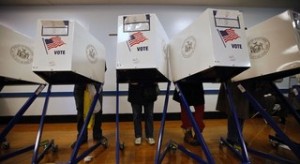
The Washington, D.C. and Prince George’s County, Md.’s modest turnout for the Nov. 4 general election may have been little better than that seen nationwide, and still made a difference in who won the contests, but leaders said there is still room for improvement.
Slightly more than 32 percent of all registered voters in the District participated in the election that decided the mayoral, attorney general, D.C. Council chairman, D.C. council member at-large and ward contests, as well as all of the advisory neighborhood commissioners’ races. The District lagged behind neighboring Prince George’s County which saw 38.03 percent of its registered voters cast ballots.
The turnout had differing results for D.C. and Maryland Democratic candidates. While D.C. Council member Muriel Bowser (D-Ward 4) was elevated to mayor-elect, Maryland Lt. Gov. Anthony Brown (D) lost to Anne Arundel businessman Larry Hogan (R).
Natalie Williams, the president of the Ward 8 Democrats, said that her organization’s Get-Out-The-Vote event produced results on Election Day.
“Considering the turnout for the city, Ward 8 was comparable to the rest of the wards,” Williams said.
On Election Day, Ward 8 had the District’s lowest voting percentage with 21.49 percent of its eligible voters casting a ballot. It was the lowest of the city’s predominantly Black wards, with neighboring Ward 7 posting 26.29 percent; Ward 5 reported 31.88 percent and Ward 4 delivered 39.56 percent. Ward 3, which is 79 percent White, had the city’s highest percentage of voter turnout at 41.34 percent. The District of Columbia is about 50 percent Black, according to the statistics compiled by the U.S. Census Bureau in 2010.
Bowser won five of the eight wards, including the four predominantly Black ones, and Ward 1, where Whites comprise 40 percent of the population.
The turnout for people of color in Ward 1, where they currently represent 33 percent of the ward’s population, is a major concern for Vicki Wright-Smith, an advisory neighborhood commissioner there.
“While I think that the turnout overall in the city is great, here in Ward 1 it was low especially for Blacks,” Wright-Smith said. “I keep an eye on who is coming to the polls and there were not that many of us. I think that efforts to get people who live east of the River are good, but we need to figure out how to get minorities engaged in Ward 1.”
Williams and Wright-Smith said several residents claimed voting in the general election was not necessary because Bowser was bound to win as the Democratic candidate. Since the advent of Home Rule in 1973, the city’s mayors have been Democrats and 76 percent of the District voters identify themselves as Democrats.
Wright-Smith said she was floored when some of her neighbors made that suggestion.
“They thought that since D.C. always elects Democratic mayors that Bowser was a shoo-in,” she said. “I had to tell them that’s not true now. While having a ‘D’ beside your name on the ballot still means something in this city, Bowser had to struggle in Wards 1, 2 and 3 for votes.”
Williams agreed with Wright-Smith.
“I hear that statement too often, nothing matters if you don’t vote,” she said. “In 1995, we had a Ward 8 council race that was decided by one vote. Everyone needs to get involved because every vote counts.”
While Brown won his home county, the predominantly Black Prince George’s County, by a wide margin, Terry Speigner, the former chairman of the Prince George’s County Democratic Central Committee, said that the lieutenant governor took his base for granted.
“He did not talk to the people he needed to talk to,” Speigner said. “He did not emotionally connect with people in Prince George’s County. Yes, he won the county in a big way but that did not help him statewide.”
In addition to Prince George’s County, Brown won Baltimore City, majority-minority Montgomery County and majority-minority Charles County. Hogan won the rest of the counties, with impressive numbers in majority White Baltimore County, Western Maryland and the Eastern Shore.
Speigner said that Brown’s loss shows that Maryland is no longer a “deep-blue” state.
“We are purple now,” he said. “We have elected two Republican governors in 10 years. The Maryland Democratic Party can no longer take the Black vote for granted.”
