

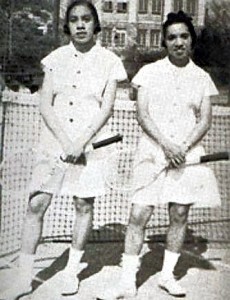
Margaret Peters and Roumania Peters Walker (Courtesy Photo)
Before the game of tennis produced noted Black players such as Althea Gibson, Arthur Ashe, or even siblings Venus and Serena Williams, there were the Peters sisters.
Margaret Peters and Roumania Peters were the first African-American tennis duo to emerge during a time when there weren’t as many opportunities for Black players—much less Black women—to attain recognition or respect in the game.
On Oct. 24, members of the District of Columbia Council and friends convened at the Rose Park in the Georgetown area of Washington, D.C., to rename its tennis courts in honor of the sisters and their contributions to the game of tennis.
The dedication included remarks from the pair’s children and students who discussed their experience taking lessons from the sisters. Secretary of Homeland Security Jeh Johnson unveiled a bronze memorial plaque and photographic exhibit panels of the sisters.
The Peters sisters’ role in the history of tennis is not widely recognized. Holding an unbeatable record of 14 doubles titles, their dynamic slices, chop shots, and ferocious backhands earned them the nicknames, Margaret “Pete” and Roumania “Re-Pete,” according to Roumania’s daughter, Fannie Walker Weekes.
“Because they were a doubles team, my aunt Margaret would make a shot and then my mother would turn around and make the same shot on the court,” Weekes said. “So that became ‘Pete’ for my aunt and then ‘Re-Pete’ because my mother would make the same shot.”
Margaret, who was born in 1915, and Roumania, born two years later, grew up in a very close-knit Black section of Georgetown to working-class parents. The duo’s tennis legacy began on the communal courts of Rose Parks, just a few blocks from their home.
Their success on the neighborhood tennis courts earned them an invitation to play in tennis competitions for the American Tennis Association, the oldest African-American sports organization in the United States founded in 1916 by a group of African-American business owners, college professors and physicians.
While playing in the ATA, the siblings also attracted the attention of Tuskegee University Athletic Director Cleveland Leigh Abbot, who recruited both sisters on full scholarships to play tennis.
Because Margaret was two years older than Roumania, she decided to wait until her sister could finish high school. Both sisters entered Tuskegee together on full scholarships in 1937.
“They were very close, even at a young age,” Weekes said, recalling stories her mother shared with her and her brother about their childhood.
During their time at Tuskegee, Roumania continued her winning streak at the ATA national, winning several singles titles in 1944 and 1946. Weekes notes that one of her mother’s biggest accomplishments was defeating another prominent tennis player, Althea Gibson, in 1946. It’s been noted that Roumania was the only player at the time capable of defeating Gibson, who became the first African-American woman to win Grand Slam titles in Wimbledon and the U.S. Open in 1957.
After graduating from Tuskegee in 1941, both sisters went on to earn their master’s degrees from New York University, before returning back home to Washington. Margaret became a special education teacher, and Roumania taught physical education at Howard University and Dunbar High School. Roumania ran a tennis camp program at Rose Park dedicated to teaching underprivileged youth tennis skills for 20 years.
Margaret, who never married or had children, died of pneumonia in 2003. Roumania, who married a Tuskegee math professor and had two kids, died in 2004.
According to David Abrams, a board member of Friends of Rose Park, a nonprofit organization established to maintain and make improvement of the park through private contributions, the park is historically known as the first integrated playgrounds in the District. He also played an integral role in spearheading the notion to have the tennis courts on Rose Park named after the siblings.
“As a child, I remember taking tennis lessons with the sisters. There were other kids from the neighborhood who would also come to the park and take turns practicing with her,” said Monica Roache, a family friend of the Peters, and the Advisory Neighborhood Commissioner for Georgetown. She said she was one of the youths who took tennis lessons from Roumania. Roache was also instrumental in working alongside Abrams to get the City Council and Ward 2 Councilmember Jack Evans on board to rename the Rose Park tennis courts.
