

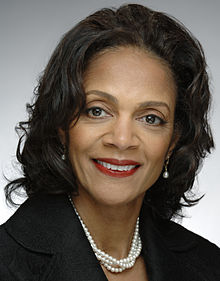
Former Mayor Sheila Dixon has announced she will seek Baltimore City’s top job in the 2016 election.
Former Mayor Sheila Dixon feels that Baltimore City has regressed in a number of key areas since she was forced to leave office in 2010. She believes her more inclusive and engaged style of leadership can change the direction of the city for the better.
“I, in my elected positions from city council, city council president, to mayor, know that our city has made tremendous strides, and I know under my leadership we made so much great progress. And over the last several years, a lot of the progress as relates to reducing crime, as relates to cleaning this city up, and attracting people to Baltimore, and dealing with health issues, declined. And it’s disheartening that things have kind of reversed selves,” said Dixon.
The former mayor, currently the director of marketing for the Maryland Minority Contractors Association, says that many residents, even people she did not know personally, have been approaching her over the last two years to re-enter Baltimore City’s political arena, and Dixon believes the city could benefit from her style of leadership.
“You need someone who can get in there, who knows how the budget works, who knows our agencies, and can get things moving in a whole other direction . . . My style of leadership is really an inclusive partnership, working in communities with community leaders and individuals, with the business community, and that’s always been my philosophy because we can get more done and accomplished when we work cohesively together than in silos,” said Dixon of her approach to governance.
It is hard not to hear in these words at least a contrast, if not an outright critique, of Mayor Stephanie Rawlings-Blakes, who faces some strong headwinds heading into 2016 over the perception that she has failed to effectively connect with many of Baltimore’s community’s, especially poorer Black ones.
Asked whether she thought the criticism that Rawlings-Blake had failed to hear all communities during her tenure was fair, Dixon said it was, and suggested that some of Rawlings-Blake’s other commitments, like her involvement in the U.S. Conference of Mayors (of which Rawlings-Blake is now president), has served as something of a distraction to her responsibilities towards Baltimore.
“ we have to wear multiple hats, but in wearing multiple hats and then having other responsibilities outside of the city, you have to then make some choices where you’re going to put most of your energies. You can’t be all over the place and then try to serve and represent the citizens, because it’s impossible . . . We have such a challenging city, it needs someone who’s going to be focused on Baltimore,” said Dixon.
The former mayor touched on a number of public policy issues including her approach to public safety. Dixon said that during her previous administration, she worked to improve officer retention, pushed a consistent focus on repeat, violent offenders, worked with state and federal partners to reduce the number of guns on the streets, and sought to have police officers directly engage the community by stepping out of their cars and getting to know the people and neighborhoods they served.
“I would enhance that whole effort that I created in the past, because I saw where, in 30 years, that was the first time that crime had gone down,” said Dixon.
Public safety is likely to be an important issue during this campaign, with the city struggling under huge increases in homicides and gun violence, while also having to navigate a tense relationship between the Baltimore Police Department and many communities who consider the department’s tactics abusive. Dixon has faced some criticism for failing to be a more vocal opponent of the zero tolerance style of policing which Martin O’Malley introduced to Baltimore during his tenure as mayor, when Dixon was serving as City Council President.
But Dixon denies failing to criticize O’Malley’s approach to policing, citing the creation of the city council’s public safety committee during her council presidency as an example of her work to push against the mantra of zero tolerance and give the council some oversight with respect to policing in Baltimore. Further, she points out that she did not continue the practice of zero tolerance after succeeding O’Malley as mayor, but instead worked to implement community-based efforts like Safe Streets, which uses ex-offenders to target those at risk for violence in order to reduce shootings in the city.
Safe Streets speaks to Dixon’s broader approach to governance, which favors direct, sustained engagement. From improving re-entry services, to increasing the number of people making use of the city’s recycling and trash pick up days, Dixon stressed the importance of regular outreach that directly touches the community.
Her approach to economic development, also stresses direct engagement, but this time of the business community. “I believe that part of the role of a mayor and city government is to work with the private sector, for them to attract businesses here to the city, and that we are the cheerleaders to provide and make sure that the permit process is going through. If there are some potential incentives that going to help and benefit those residents , then our role is to work with the private sector to make it easier and more affordable to want to be located here,” said Dixon, who did not push back on the suggestion that there did not appear to be much daylight between her approach to economic development and what our current mayor has sought to do during her tenure.
Where Dixon does distinguish herself, however, is on insisting that we have to find alternative uses for abandoned lots and vacant homes rather than hoping they will be filled with residents one day.
“We’re not going to necessarily attract back the number of people we had in the past, over a million people. Baltimore County will be at a million before we are, we’ll be at 500,000. But in those areas where we see different neighborhoods where we can create more green space, where we might even have to create some industrial space that could potentially attract some light manufacturing to come back and look at Baltimore,” said Dixon.
She addressed the scandal which forced her out of office back in 2010. Dixon says she made a mistake in failing to disclose her romantic relationship with developer Ronald Lipscomb, acknowledging that she received gifts from him, but denying that he ever received any direct benefit from the city as a result of their relationship or that she ever used the gift cards intended for the poor that were at the center of the scandal.
“The cards went to charitable purposes,” said Dixon. “I received gifts. And we took care of a lot of people, for a number of years, through that program that we personally established through our own personal money.”
Dixon says she has learned from her mistakes and that she is asking for a second chance from a city she argues she never gave up on.“During those challenging times that I went through that whole ordeal, I never stopped doing my work for the citizens of Baltimore. And I could’ve just checked out, but I didn’t, because I knew that ultimately my responsibility,” said Dixon.
