

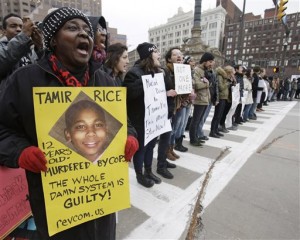
In this Nov. 25, 2014 file photo, demonstrators block Public Square in Cleveland, during a protest over the police shooting of 12-year-old Tamir Rice. The attorneys for the family of Rice shot by a white Cleveland police officer while carrying a pellet gun have asked the U.S. Justice Department to investigate both the killing and the conduct of the prosecutor in charge of the case. (AP Photo/Tony Dejak, File)
CLEVELAND (AP) — Nearly 400 days after a White police officer fatally shot a Black 12-year-old carrying a pellet gun in an encounter captured on surveillance video, the boy’s disillusioned family believes it’s unlikely anyone will be indicted.
A decision on whether to charge the officer or his partner in the death of Tamir Rice — one of the higher-profile cases of Black deaths at the hands of police that have roiled cities nationwide — could come any day. The grand jury making the decision has been meeting since mid-October.
The video shows patrolman Timothy Loehmann, a rookie at the time, shooting Tamir in an instant as the cruiser driven by patrolman Frank Garmback skids to a stop on Nov. 22, 2014. Tamir died the next day during surgery, and his family has repeatedly questioned why the case has dragged on.
Subodh Chandra, a Cleveland attorney who represents the Rice family in a federal civil rights lawsuit over the shooting, said he has resigned himself to the belief that the officers, both white, won’t be indicted.
“This is apparently how long it takes to engineer denying justice to a family when the video of the incident clearly illustrates probable cause to charge the officer,” Chandra said.
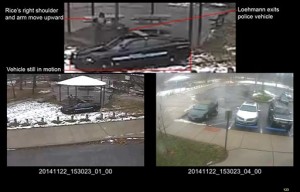
This combination of still images taken from a surveillance video and released Saturday, Nov. 28, 2015, by the Cuyahoga County Prosecutor’s Office, shows Cleveland police officers arriving at Cudell Park on a report of a man with a gun. Twelve-year-old Tamir Rice was fatally shot by Cleveland police officer Timothy Loehmann, Nov. 22, 2014, after he reportedly pulled a replica gun at the city park. The enhancement by a California video expert will be presented to a grand jury that will decide if then-rookie patrolman Loehmann or his training officer should be charged criminally for Loehmann killing Rice. (Cuyahoga County Prosecutor’s Office via AP)
Unlike criminal trials, in which prosecutors must prove guilt beyond a reasonable doubt for a conviction, the burden of proof for an indictment is much lower. The grand jury would have to decide only that a crime might have been committed to indict the officers.
Activists used an obscure state law in June to petition a Cleveland judge to charge the officers. The judge ruled there was probable cause to charge Loehmann with murder and Garmback with reckless homicide based on the video, but he said the decision on criminal charges should be left to prosecutors.
The lead agency investigation the shooting, the Cuyahoga County Sheriff’s Office, turned over its findings in June to county prosecutor Tim McGinty.
Investigations and grand jury decisions in other high-profile deaths have come much faster. It took about three months from the time Michael Brown was fatally shot in Ferguson, Missouri, for a grand jury to decide against charges. A grand jury indicted six police officers in Baltimore three weeks after the death of Freddie Gray while in police custody.
McGinty spokesman Joe Frolik attributed the lengthy investigation in Tamir’s case to the office being “careful and thorough.”
Grand jury proceedings are supposed to be secret, but McGinty has released expert reports and investigative documents to the media and public while citing his desire for transparency in how the case is being handled.
On the day Tamir was shot, a man drinking a beer and waiting for a bus outside a recreation center called 911 to report that a man was waving a gun and pointing it at people. Tamir lived across the street from the recreation center and went there to play nearly every day.
The man told the 911 call taker that the holder of the gun was likely a juvenile and that the gun probably wasn’t real. The call taker never passed that information to the dispatcher who gave Loehmann and Garmback the high-priority call.
When the cruiser arrived, the vehicle skidded on wet grass and stopped within feet of the boy. Authorities say Loehmann shot Tamir less than two seconds after opening the cruiser door.
The officers said they repeatedly yelled at Tamir to put his hands up, although investigators found no evidence of that. Garmback said the windows of the cruiser were rolled up.
In the video, Tamir walks toward the cruiser as it moves toward him. It’s unclear even in an enhanced version of the video whether Tamir was reaching for the gun or had his hand on it when Loehmann shot him.
The boy lay unattended for about four minutes until an FBI agent who is a trained paramedic arrived and began administering first aid.
Tamir was carrying a plastic airsoft gun that shoots nonlethal plastic projectiles and is a replica of an actual firearm. He had borrowed it that morning from a friend who warned him to be careful because the gun looked real.
Experts hired by McGinty concluded the shooting was justified. Experts hired by the Rice family concluded otherwise. Both sets testified before the grand jury.
McGinty has said prosecutors will make a recommendation to the grand jury on charges before the panel votes.
If Loehmann feared for his life, the shooting was reasonable and justified, said Maria Haberfeld, a professor at the John Jay College of Criminal Justice in New York who isn’t involved in the case.
“Police officers are not obligated to figure out what’s going on in someone’s mind when they have a gun,” she said. “He’s arriving to the scene in fear for his life. This might be his or her last response call.”
