

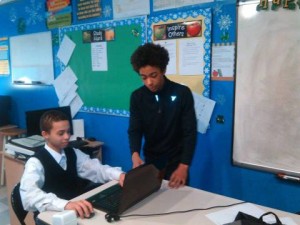
Students working together at Gifted Academy Preparatory School. (Photo courtesy of Gifted Academy Preparatory School)
As adolescent bullying permeates schoolyards across the country, prevention campaigns have formed from grassroots organizations and government agencies alike. Native Washingtonian Theresa Garza is a longtime advocate for safer learning environments for children as the director of Gifted Academy Preparatory School, located on the edge of Capitol Hill in Southeast, D.C.
Garza started the private learning center in October of 2005, after her daughter faced a bully at her school – the same place where Garza worked as an educator. “I brought her and my son home and decided that I would homeschool them for the rest of the school year and the following upcoming school year I would look for a job,” Garza told the AFRO on May 11. “In the process of home schooling them, I really liked knowing what they were learning, I liked their progression and I enjoyed the time we spent together. It also allowed me time to be able to go to school at night and complete my master’s.”
As other parents heard of Garza’s efforts, a considerable amount of interest grew and soon she launched Gifted Academy. Operating in her home, Garza can accommodate up to twelve children at once from first graders to high school seniors. Primary classes include reading, English, history, mathematics and science. Older students engage in college preparatory courses such as physics, geometry, and a foreign language, along with an array of electives.
Perhaps the most important part of the program is its Christ-centered approach. “Being a Christian myself, I truly believe that the missing part of the formula in most schools is religion because religion gives a structure and its hard to have structure when you don’t have a definite right and a definite wrong. So with Christ and with the Bible you have a definite idea of what’s right and what’s wrong.”
Students at the academy are also unique, in that they often battle learning or physical disabilities that would make them targets for discrimination in traditional schools, “I currently have a twelfth grader who is autistic… one of my ninth grade students is a cancer survivor twice… I’ve had students in the past who had eczema to the extent that their skin looked like leather… I’ve had a student who was extremely obese at the age of 11, he weighed over 350 pounds,” recalls Garza, who works to address each student’s situations with the utmost care.
While many educators may stray from such environments, Garza’s personalized approach has propelled her throughout the decades and made her a trendsetter in D.C. education. “There have been some challenges in figuring out how to teach certain things to certain people, but that comes along with teaching in general,” she says. “ seeing the light bulb come on in a child’s eyes when you know a child has it, when they’ve caught something. Most people don’t think they can learn math and when they are able to accomplish that, that’s the most rewarding.”
