

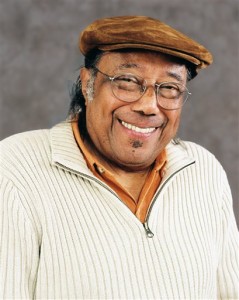
Musician Horace Silver. Silver, a pianist, composer and band leader with a tireless inventiveness who influenced generations of jazzmen with his distinctive hard bop sound. (AP Photo/National Endowment for the Arts, Tom Pich)
Horace Silver, a pianist, composer and band leader with a tireless inventiveness who influenced generations of jazzmen with his distinctive hard bop sound, has died. He was 85.
The Westchester County Medical Examiner’s Office confirmed that Silver died Wednesday in New Rochelle, New York, but had no other information.
“Horace Silver was one of the hardest swinging piano players in jazz, both as a section player and a soloist,” said Ramsey Lewis, a pianist influenced by Silver. “Moreover, he was one of the finest human beings that walked the earth.”
And one of the most influential, carving a sizeable wake through the jazz world in a career that seemed special from the start.
The pianist was something of a prodigy and moved to New York at the insistence of Stan Getz in the early 1950s after the famed saxophone player hired a rhythm section that included Silver for a one-off in Hartford, Connecticut. Silver was just 21.
He played with Getz for a while — Getz would record some of his early compositions — and other towering pioneers like Lester Young and Coleman Hawkins. He soon began a series of collaborations and recordings that remain highly influential in jazz a half-century later — starting with his partnership with drummer Art Blakey that led to the seminal hard bop album “Horace Silver and the Jazz Messengers” in 1955.
Though he eventually left the Messengers, Silver continued a string of milestone albums for Blue Note, a label he recorded for until 1980, which are still referenced often, including “Six Pieces of Silver” in 1956 and “Blowin’ The Blues Away” in 1959.
Silver’s father was born in Cape Verde and the folk music of that island nation was always part of his influences. An innately funky player with a keen sense of style, he also incorporated the blues and gospel into his compositions, modernizing jazz at the same time those sounds were transforming other genres like rock ‘n’ roll and R&B.
“It’s like making a stew,” Silver said in a 2003 All About Jazz interview. “You put all these various ingredients in it. You season it with this. You put that in it. You put the other in it. You mix it all up and it comes out something neat, something that you created.”
Songs like “The Preacher,” ”Song for My Father” and the evocatively titled “Filthy McNasty” showed the possibilities of jazz when leavened with other sounds, and his experimentation would not end there. He eventually began to include lyrics with his works and explored social and political themes in his music in the 1960s and ’70s, even dabbling in what he described as cosmic philosophy.

Neil Portnow, left, president of the Recording Academy, Horace Silver, center, and Dan Carlin, chairman of The Recording Academy, during the GRAMMY Salute to Jazz in Los Angeles. (AP Photo/Courtesy The Recording Academy)
“Horace Silver’s music has always represented what jazz musicians preach but don’t necessarily practice, and that’s simplicity,” bassist Christian McBride told NPR in 2008. “It sticks to the memory. It’s very singable. It gets in your blood easily. You can comprehend it easily. It’s very rooted, very soulful.”
Silver, born Horace Ward Martin Tavares Silva in 1928 in Norwalk, Connecticut, moved to Los Angeles later in his career. He was nominated for a Grammy Award in 1995 for his album “Hard Bop Grandpop” and in 2005 the National Academy of Recording Arts and Sciences gave him its president’s merit award.
His most widely heard composition, however, was not one he recorded himself. The rock group Steely Dan borrowed a riff from “Song for My Father” for their 1974 hit “Rikki, Don’t Lose That Number,” a song that remains in heavy rotation on classic rock and oldies stations.
___
AP writer Charles J. Gans in New York contributed to this report.

