


Afro Charities, in partnership with the Lillie May Carroll Jackson Civil Rights Museum, recently held a session of the “ReReading the News Conversation Series.”

The program, titled “Lillie May Carroll Jackson: A Legacy of Motherhood and Activism,” centered on the enduring impact of Dr. Lillie May Carroll Jackson—widely regarded as the mother of the civil rights movement.
Dr. Iris Barnes, associate director and curator of the Lillie Carroll Jackson Civil Rights Museum, reflected on Jackson’s powerful legacy.
“Dr. Lillie Carroll Jackson was more than a civil rights leader—she was a strategist, a mother and a force who challenged systems with dignity and power,” Dr. Barnes said. “Her story, long chronicled by the AFRO, reminds us that the fight for justice was not spontaneous—it was organized, led and sustained by Black women like her.”
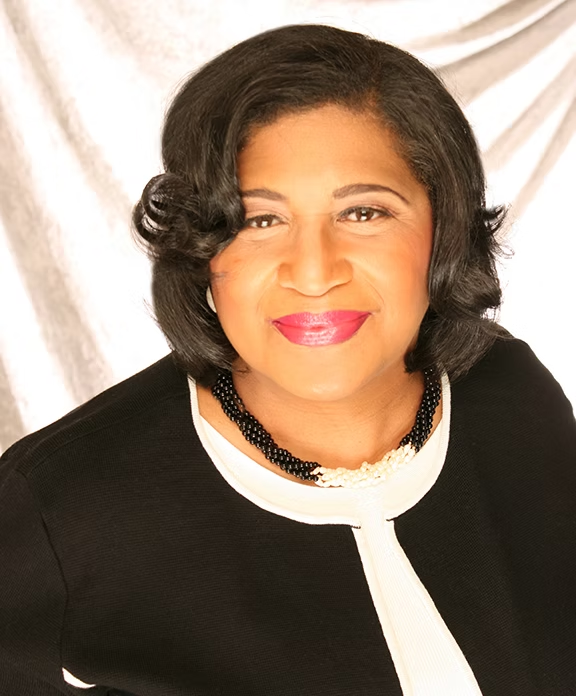
Credit: Courtesy photo/ Dr. Iris Barnes
The event highlighted Jackson’s pivotal leadership in the Baltimore branch of the NAACP and her lasting contributions to nonviolent resistance, which influenced civil rights strategies nationwide. A particular focus of the session was her 1957 recognition as the AFRO’s “Ideal Mother”—an award celebrating Black motherhood, leadership and civic engagement through a nationally recognized contest held from 1946 to 1957.
True to form, the latest part of the “ReReading the News” series began with a historical article from the AFRO American Newspaper, drawn from the AFRO Archives. Each reading serves as the foundation for an intergenerational discussion that connects the past to the present through dialogue with scholars and community leaders.
Savannah Wood, executive director of Afro Charities, spoke to the power of bridging history and contemporary life in meaningful ways.
“Afro Charities brings history to life by connecting the archives to the present. This event did that beautifully, linking a historical figure to today through her living descendant,” Wood said. “It reminds us that we’re not so different from the heroes of the past—and that we, too, have the power to create change in our communities.”

The panel featured voices with deep ties to Jackson’s legacy: Dr. Iris Barnes; Lisa Mitchell-Sennaar, Jackson’s great-great-granddaughter, and Wood. The discussion was moderated by Deyane Moses, Afro Charities’ director of programs and partnerships.
“It was a great conversation. I had never met Lisa Mitchell-Sennaar. Connecting with her and hearing personal stories about Dr. Jackson’s life and legacy was a highlight,” Wood said. “I also learned that Dr. Jackson was a singer and her husband was a filmmaker who toured religious films throughout the South—details you rarely find in official archives.”
Moses emphasized the importance of collaborative programs in increasing visibility for local institutions and building shared audiences.

“Collaborative events like this help us reach new audiences and share our missions. More than 100 participants joined across platforms and many learned for the first time that Lillie May Carroll Jackson’s home is a museum right here in Baltimore,” Moses said.
The panel also explored the cultural and historical significance of the “Ideal Mother” contest. Through Jackson’s life, they examined themes of maternal leadership, community resilience and the crucial role of Black women in social justice movements.
“She encouraged her children to explore their passions, cultivate their talents and serve their communities all at once—laying a foundation of civic responsibility that continues to resonate,” Dr. Barnes said. “At the Lillie Carroll Jackson Civil Rights Museum, we are honored to lift her legacy alongside Afro Charities and to re-examine the headlines that shaped—and were shaped by—her fearless leadership.”
The event is part of Afro Charities’ ongoing mission to preserve and activate the AFRO Archives while fostering community conversations inspired by Black history and journalism.
“We had the opportunity to tell our story while also uplifting our partners,” Moses said. “People learned about Afro Charities, the AFRO Archives, AFRO News and the revitalization of the Upton Mansion, which will be our future home.”