

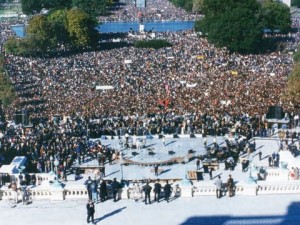
On Oct. 16, 1995 many converged on the Mall in Washington D.C. Twenty years later, challenges remain. (Photo by JD Howard)
The 20th anniversary commemoration of the Million Man March, with the theme of “Justice… or Else!” will take place on Oct. 10 on the National Mall in the District. Nation of Islam Minister Ishmael Muhammad, who is the national assistant minister to Nation of Islam Minister Louis Farrakhan, said that the Million Man March was a historic event, but there is much work to be done to accomplish its aims.
“Twenty years ago, Black men came to Washington, D.C. under the theme of ‘Atonement, Reconciliation and Responsibility’,” Muhammad told the {AFRO}. “We were there, Muslim, Christian, and Hebrew, and we saw each other as brothers. But today, we are facing challenges in the Black community such as widespread death, increased violence, and police violence in our community.”
Muhammad said that marchers on Oct. 10 will come back to Washington to make demands on their federal lawmakers. “We want equal justice under the law,” Muhammad said. “We will have some demands that we will be put forth to the U.S. Congress in the form of a program.”
The Million Man March took place on the National Mall on Oct. 16, 1995. Millions of Black men from around the country listened to speakers such as the Rev. Jesse Jackson, the chairman of the Congressional Black Caucus U.S. Rep. Donald Payne (D-N.J.), and female speakers including Maya Angelou, Rosa Parks, then D.C. first lady Cora Masters Barry, Dr. E. Faye Williams, and Dr. Betty Shabazz, widow of Malcolm X.
The national coordinator of the event was the Rev. Benjamin Chavis, the current president and CEO of the National Newspaper Publishers Association. Farrakhan delivered the keynote address then and will be the primary speaker on Oct. 10. At the 1995 march, Farrakhan implored the men to clean up themselves, protect their women and families, support Black businesses, and register to vote.
There was a tenth anniversary event in 2005 but it didn’t receive the attention the original event did.
Some observers of the 20th anniversary march have raised concerns about the confrontational tone of the theme “Justice…or Else!” and have suggested a more universal statement of brotherhood and peace. Muhammad said that this year’s theme had a purpose. “The theme represents the seriousness of the time we live in,” he said. “We have problems in our community and we don’t need a theme that is nice and palatable. There is no peace in this society and we are demanding fair treatment and to be dealt with fairly.”
Some critics of the 1995 march pointed out that the concerns of women were largely ignored even though there were prominent female speakers and supporters. Muhammad said that everyone is invited to this year’s event. “Women will be with us as well as families,” he said. “We have invited the Hispanic and Native American communities as well as the poor of any color.”
The day’s events start at 10 a.m. There will be speakers from the Hispanic and Native American communities and orators on such topics such as domestic abuse, health, income inequalities, and education. “We want to focus on solutions and correct these problems,” he said.
The 1995 march took months to plan. In the Washington, D.C. area, local organizing committees met weekly to discuss the march’s logistics and media outreach. This year, the approach is different. “Things are done much more differently now,” Muhammad said. “We are reaching out to people through social media and the march has blown up on that. People can find out what they need on JusticeorElse.com.”
Muhammad said that while Oct. 10 is an important day, what happens after Oct. 11 is more important. “We will build on the local organizing committee structure to try to implement our agenda,” he said.
