


The Rev. Dr. Cleveland T.A. Mason II offers prayer in the sanctuary of his church, Perkins Square Baptist on Edmondson Avenue.
On July 23, 2014, the Rev. Dr. Cleveland Mason was installed as the president of the United Baptist Missionary Convention, a convention of Baptist African-American churches founded in 1829. Mason brings to the office a vision of a church thoroughly engaged in community building, and is the first president of the convention to be elected by popular vote rather than ascending to the position through a leadership succession.
Mason, senior pastor at Perkins Square Baptist Church on Edmondson Avenue, discussed the changes to the executive officer selection process and his vision for the convention moving forward.
According to Mason, the previous president, Dr. James Gray, implemented constitutional changes to establish the electoral process. Using an election, it was believed, would improve the quality of officeholders and open the doors to those without an opportunity to enter the succession line.
The convention has 60 active churches throughout Maryland, though most are located in Baltimore. Mason hopes to expand the convention by reconnecting churches that drifted away from the Convention and reaching out to newer ministries to interest them in belonging. “You can do more when you have more partners working together,” said Mason.
Having declared the theme of his presidency to be ‘Rebuilding Community: Keeping Christ at the Center,” Mason wants to get the churches more engaged in the immediate needs of their surrounding communities. He explained that many churches, including his own, no longer count their immediate neighbors among their membership.
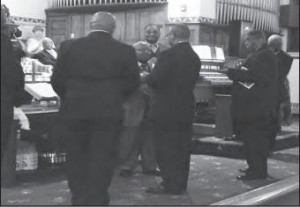
The passing of the gavel from outgoing president, the Rev. William Gray to the Rev. Dr. Cleveland T.A. Mason II, newly installed as the president of the United Baptist Missionary Convention.
One of the ways he hopes to better serve the community is by addressing duplicative ministries, to free up resources for other forms of community engagement. “In some instances, churches in close proximity that are doing similar ministry,” said Mason. “You’re reproducing something over here that’s being done over there and there’s no partnership in between to support that. But the needs of the wider community are so great and so vast, it would be more helpful if we could partner up with some things and not have so much duplication.”Among the duplications, he sees are too many churches with similar soup kitchen and clothing ministries. “It creates a different dynamic when the church is in community that has a number of economic needs, social needs,” said Mason. “We’ve got the crime issue, the drug issue, and just impoverished people who are at or below the poverty line. Senior persons who are living in homes that they cannot necessarily financially afford the upkeep of, because their present income does not allow them to fix everything that needs to be fixed on the home and that kind of thing. So there are needs that I see the church community needing to help people with. If we partner together we can be stronger in reaching our goals of helping families to survive.”
Mason has already begun his work in the direction of increased partnership and cooperation in the convention’s ministry. Recently, Mason joined the heads of St. Mark Institutional Baptist Church, Abyssinia (also a Baptist congregation), and Union Memorial Methodist Church to address a different need caused by the city’s regular bouts of violence. “We decided as community pastors that we wanted to work together to do some things to aid the people in the community,” said Mason. “Those who have grieving issues because of the violence in our community, who’ve been greatly affected by the loss of loved ones, we have taken on the responsibility to do some things to minister to them. Reaching out to them as opposed to just waiting for them to come to us because there’s been a detachment over the years where people in the community, they’ve not come to the church.”
In addition to establishing a deeper and more effective engagement in the community, Mason wants to see its predominantly African-American churches become more inclusive and attract more of the region’s growing Latino and other ethnic populations.
Ultimately, Mason says, following Christ’s example of always preaching, teaching, and healing is what must guide the convention as it moves forward. “If we can improve people’s situation, I believe we’ve done some healing,” said Mason. “If we can help them to look at life from a different perspective, we’ve done some healing. If we can improve relationships, if we can help husbands and wives to have a better relationship, if we can have parents and children have a better relationship, we’re doing some healing and that’s what Jesus wanted to see happen.”

