

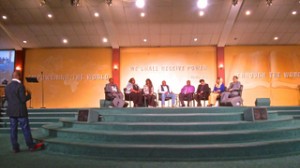
Rev. Jamal Bryant addresses a panel at a domestic violence summit at Empowerment Temple on Sept. 30. (Photo by Roberto Alejandro)
Eight panelists addressed the problem of domestic violence at a recent forum on the topic facilitated by the Rev. Jamal Bryant at his Empowerment Temple in West Baltimore. The group included representatives of the law enforcement, social work, spiritual, and mental health arenas, as well as male and female survivors and professed former abusers.
Bryant spoke of the “woefully under-discussed . . . crime of domestic violence” early on, calling it an issue that was “very vital and very critical and very crucial for our community.”
“So many times we can get riled up about a police officer, or someone of another ethnicity, but we become ‘Silence of the Lambs’ when it affects our own house,” he said. “But we’ve come to the place where we can no longer sweep it under the carpet, because now there’s a lump in the living room.”
Bryant said he wanted the church to be at the forefront of the discussion on domestic violence in the Black community, and acknowledged that the church has been complicit in the problem, often advising survivors who stepped forward to simply “stay and pray through it.”
The discussion ranged beyond intimate partner violence to address the broader problem of violence in the home.
QueenAfi Gaston, a former abuser of male partners, spoke about the number of teenage girls living in homes where anger and verbal abuse are a norm. “We’ve also got teenage girls that are in households that are abusive, and they’re learning. In my household, my mother my grandmother were strong, aggressive women, so I learned some behaviors there, verbal abuse…being No. 1…. We have to continue to work and identify all of the types of domestic violence,” said Gaston, who noted the connection between verbal and physical forms of violence.
The focus of the event, however, remained on intimate partner violence, and local activist Mothyna James-Brightful spoke to everyone’s responsibility when it comes to instances of domestic violence, after being asked by Bryant what the responsibility of the church is when it becomes aware of such an instance.
“Your responsibility is to act on what you’ve heard and what you know. Once you know it, you cannot un-know it,” said James-Brightful, who called on all parishioners to demand that domestic violence be a regular topic of discussion in their congregation, because the church acknowledges that this is a problem that almost certainly affects someone among them.
ralejandro@afro.com
