


There is a loud buzz surrounding civil rights drama Selma.
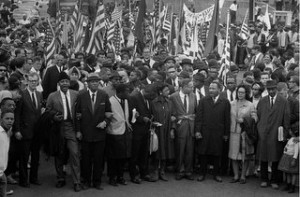
Original caption: Dr. Martin Luther King (center) leads an estimated 10,00 or more civil rights marchers out on the last leg of their Selma-to-Montgomery march. Others identifiable in front row include: John Lewis, (2d from left) of SNCC; King’s aide, Reverend Ralph Abernathy (3rd from left); Dr. Ralph Bunche (5th from left, looking to side); Mrs. King (next to King); and Rev. Hosea Williams (carrying little girl, right). (Copyright Bettmann/Corbis / AP Images)
The film, partly a profile of Dr. Martin Luther King Jr. but mostly a dramatization of pivotal civil rights marches from Selma to Montgomery, Ala., in 1965, highlights what Temple University professor Molefi Kete Asante called one of the most “historic” and “heroic” moments in the nation’s history. The protestors were agitating to achieve equal voting rights for Black Americans.
On the one hand, Selma has received critical acclaim, garnering several Golden Globes nominations and considered an Oscar contender.
“I loved the film. The film is so real…it’s powerful…it made me cry,” said Rep. John Lewis, D-Ga., who was severely beaten during the March 7, 1965 march that came to be known as Bloody Sunday, in an interview with MSNBC’s Andrea Mitchell.
The very existence of the film is in itself a great achievement since “Hollywood for so long had avoided a film about Dr. King and the Civil Rights Movement,” said Gary May, history professor at University of Delaware.
May, like many others, also praised the film’s elevation of the protestors’ role as agents of their own destiny. “At last, African Americans are the heroes of their own story,” he said.
Others are not so laudatory, however, particularly supporters of President Lyndon Johnson who said he was unjustly portrayed. The film downplays Johnson’s role, shows him as waffling on the voting rights legislation in favor of the War on Poverty, and as having a contentious relationship with Dr. King.
In an opinion piece for the Washington Post, former Johnson advisor Joseph A. Califano Jr. said the film should be shunned.
“The film falsely portrays President Lyndon B. Johnson as being at odds with Martin Luther King Jr. and even using the FBI to discredit him, as only reluctantly behind the Voting Rights Act of 1965 and as opposed to the Selma march itself,” Califano wrote.
“In fact, Selma was LBJ’s idea, he considered the Voting Rights Act his greatest legislative achievement, he viewed King as an essential partner in getting it enacted — and he didn’t use the FBI to disparage him.”
Mark Updegrove, director of the LBJ Presidential Library, also decried the characterization of Johnson, saying it “flies in the face of history.”
“In truth,” he added, “the partnership between LBJ and MLK on civil rights is one of the most productive and consequential in American history.”
The film’s director, Ava DuVernay lambasted Califano’s assertion that Selma was the president’s idea and civil rights leaders agreed. “Notion that Selma was LBJ’s idea is jaw dropping and offensive to SNCC, SCLC and Black people who made it so,” she wrote on Twitter.
She also defended her choice to change the script, which originally was more slanted to Johnson and his role.
“I wasn’t interested in making a white-savior movie; I was interested in making a viecentered on the people of Selma,” she told Rolling Stone.
“What’s important for me as a student of this time in history is to not deify what the president did,” she added. “Johnson has been hailed as a hero of that time, and he was, but we’re talking about a reluctant hero. He was cajoled and pushed, he was protective of a legacy — he was not doing things out of the goodness of his heart.”
Historians and civil rights leaders agree that President Johnson did express misgivings about introducing the Voting Rights Act so soon after passing the 1964 Civil Rights Act, while Dr. King felt the urgency of immediate action. Still, that didn’t mean they were enemies.
“The film’s suggestion that Johnson was an enemy of King was just wrong.The most serious problem is the film’s depiction of Johnson being involved in J. Edgar Hoover’s efforts to smear Dr. King. There’s no question that Hoover set out to destroy King’s life and reputation. But there is no evidence that Johnson was involved,” said May, who also criticized aspects of the film.
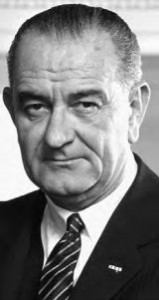
Lyndon B. Johnson.
“Johnson would have preferred, I think, working with older, more established civil rights leaders like the NAACP’s then-president Roy Wilkins…people he could control,” added the professor and author of Bending Toward Justice: The Voting Rights Act and the Transformation of American Democracy. Still, Johnson and King were allies.
“They were somewhat uncomfortable allies, but they shared the same goals. The problem is that while Johnson and King had the same goal, they had different timetables.”
Black leaders with firsthand knowledge of the pair’s interactions agree.
“Dr. King wanted to move, we all wanted to move make this thing happen,”
Lewis, then-leader of SNCC, recalled. “President Johnson wanted to wait and not move so fast. He said in effect, ‘I just signed a Civil Rights Act. We don’t have the votes in Congress. If you want me to get a voting rights bill passed, make me do it.”
Andrew Young, Dr. King’s lieutenant and a frequent participant in the negotiations between the White House and the Civil Rights Movement, concurred.
The relationship between Dr. King and President Johnson was “intense” and there were often “gentlemen’s disagreements” but the pair remained cordial, he recalled in a panel discussion at the LBJ Library’s Civil Rights Summit last April “Dr. King saw himself as having to keep the pressure on,” Young said, while Johnson had to weigh political considerations.
“Right after the Nobel Prize, President Johnson talked for an hour about why he didn’t have the power to introduce voting rights legislation in 1965, and gave very good reasons,” Young added. “He kept saying, ‘I just don’t have the power. I wish I did.’ When we left, I asked Dr. King, ‘Well, what did you think?’ He said, ‘I think we’ve got to figure out a way to get this president some power.’”
The marches on Selma–then a jurisdiction with some of the most egregious examples of Black disenfranchisement–was the answer. The images of nonviolent protesters being bloodied, bruised and brutalized seared the national conscience and gave Johnson the impetus he needed. On March 15, he gave an address before a joint session of Congress in which he invoked the civil rights mantra that “we shall overcome.” The next day, the voting rights bill was introduced.
Despite whatever initial hesitation he may have felt, Johnson played an undeniably integral role in the Voting Rights Act‘s passage, Norton said.
“With the 1965 act coming so closely on the heels of the Civil Rights Act, it would have been difficult to pass without two key ingredients: The march on Selma was one. The other ingredient was, perhaps, the most important legislator the Congress had ever seen–Lyndon Baines Johnson,” she said.
The VRA was much more challenging politically and would be met with more resistance, the lawmaker added. “There was a reason the Civil Rights Movement went with the Civil Rights Act first. By going for voting rights you were going straight to theheart of the White Democratic racist power structure.”
That’s why the legislation needed someone with Johnson’s “singular” legislative skills and the uncanny ability to deliver votes, she added.
“The people standing in the way were his friends, Southern Democrats,” Norton said.
“So it took a lot of guts and a lot of skill.”