

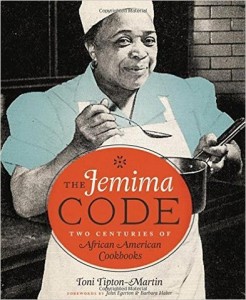
For decades, Black cooks and food service professionals were ignored. They were characterized by mainstream White America as ignorant and illiterate, capable of cooking and not much else. Writer Toni Tipton-Martin’s dismisses this line of thinking in her new book, “The Jemima Code: Two Centuries of African American Cookbooks”. In it, she highlights the black cook as a scientist, a finely tuned craft-person and in many cases, a shrewd business person.
Tipton-Martin is a veteran food writer who began amassing of the world’s largest private collections of Black cookbooks many years ago.
In her book, she offers readers a peek into the past by taking them through some of the most noteworthy books in her collection. The books range from instructional manuals produced in the 19th century to more modern ones published in the late-1980’s. Some are riddled with misspellings, others are sophisticated books created by middle-class Black ladies’ groups. There is even a 1939 cookbook from a black woman who, Tipton-Martin writes, “had the kind of professional swagger celebrity chefs demonstrate today.”
There are also pages from white cookbooks. Many of these books were created by white women who were looking to recreate favorite dishes that their mammies or “aunts” cooked for them when they were children. They were often adorned with images of overweight, matronly black women and often diminished the highly-skilled techniques black woman used to turn out dishes like perfectly fried chicken or delicious shrimp and grits.
“Throughout the twentieth century, the Aunt Jemima advertising trademark and the mythical mammy figure in southern literature provided a shorthand translation for a subtle message that went something like this: “If slaves can cook, you can too,” or “Buy this flour and you’ll cook with the same black magic that Jemima put into her pancakes.” Tipton-Martin writes. “In short: a sham.”
Black cooks had to be skilled in many ways, Tipton-Martin writes. She touches on the ways black cooks were able to preserve ancient cooking techniques from their homelands, blending them with European and Native American tastes and techniques to create something new.
She asserts that a cookbook is not just a cookbook. For it to be successful, it must engage the reader with clever writing, stories and illustrations. The writer must also convince the reader that he or she knew what they were doing. Despite the oppressive and all-consuming nature of racism, many early Black cookbook writers were able to do just that.
Tipton-Martin says that Black people must remember these early writers, because the prejudices and stereotypes that they faced continue today.
“In the absence of a written history that defies—or at least counterbalances—the stereotype, the picture of an African American woman in our national mind’s eye still resembles an insensitive exaggeration. At least for some,” she writes.
“I know that we cannot take back three hundred years of harsh words and pictures, but I believe it is possible to undo some of the damage just by looking at the vast diversity of talents and abilities displayed by African American food professionals through the cookbooks they left behind. And thereby seeing ourselves.”
