

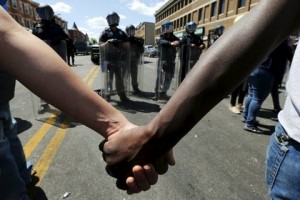
Last Saturday, a sunny and mild day, 25-30 people gathered at the Gilmore Homes, where Freddie Gray grew up. As youth held up anti-violence posters and listened to pastor Rodney Hudson, members of his Ames Memorial United Methodist Church got the assembled marchers ready to go as another group arrived on the scene.
While Hudson’s group sought to focus on Black on Black violence, this new group, fronted by Tay Lawrence of the communistRevcom.us, wanted to spotlight violence perpetuated by the police against citizens. They were also more confrontational with the assembled light police presence; chanting curse words at them and holding up their middle fingers at the police.
After a quick mini-conference the two groups agreed to put their differences behind them and set off for City Hall, about 2.5 miles away. Having only moved to Baltimore last year, walking at a slow pace through the different neighborhoods was a revealing experience. It is one thing to know that some areas are better off than others, it is another to walk their streets. The seemingly endless rows of abandoned and boarded up buildings, the closed businesses and gang-related graffiti are well known. Less obvious are the neighborhood entrepreneurs – the people with their grills out selling freshly made hamburgers and hot dogs, sellers of flavored ice – and people trying to keep their patch of Baltimore clean despite being surrounded by trash-strewn streets.
The neighborhoods change slowly. One minute march leaders were pointing out where three people had been killed that morning, the next we were on the outskirts of downtown. The businesses went from primarily churches, pawn shops, and liquor stores to coffee chains, national fast food joints, and office buildings. As we got closer to City Hall, even though it was a Saturday afternoon, you could easily imagine office workers striding to their desk jobs, something impossible to contemplate just a few blocks away.
Not that downtown Baltimore doesn’t have its own problems. The row of strip clubs on E. Baltimore Street, one block over from City Hall, attests to that.
The problems of Baltimore are many and varied. There were too many murders and shootings before Freddie Gray and that trend continues although now it gets a lot more attention. Whether something can be done remains to be seen. That 18 people were shot over the Memorial Day weekend does not indicate that it can.
Lately I have been listening to a Baltimore Club remix of “We Shall Overcome” by local Baltimore DJ James Nasty that was posted online five months ago. It takes the melancholy piano of the original civil rights staple song and mixes it with current protest chants such as “No racist police,” “No Justice, No Peace” and “Hands Up, Don’t Shoot.” Between it layers in short snippets of contemporary protest leaders talking about Freddie Gray and the injustice of his situation and the out of control violence over the signature skittery Baltimore club sound. It is not the answer to what’s going on, but it gives me hope.
Kamau High is a journalist living in Baltimore. He has written for publications including The Wall Street Journal, The Financial Times, Billboard and The Baltimore Sun. He can be reached at kamauhigh@yahoo.com.
