


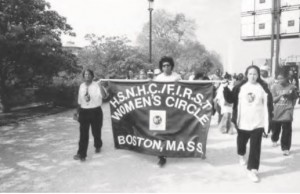
A women’s organization in Boston participated in the Million Man March in 1995. (Photo by JD Howard)
In 1995, Nation of Islam leaders did not encourage women to participate in the Million Man March, however, that is not the case for the 20th anniversary.
During the 2015 march, women will play a central role in the Oct. 10 event on the National Mall with the theme of “Justice or Else!” To generate support, scores of women with a few men participated in a pre-march rally on Oct. 4 at the Union Temple Baptist Church in Southeast D.C.
“Women have unique concerns about justice for our families and communities,” the Rev. Willie Wilson, senior pastor at Union Temple, said at the rally.
In 1995, Nation of Islam Leader Louis Farrakhan urged women not to come to the Million Man March because he, and the other leaders, wanted the men assembled to focus on atonement for areas in which they were lacking. March leaders couldn’t legally bar women from participating because the National Mall, where it was held, is federal property and is open to everyone.
Farrakhan’s suggestion was supported by the female members of the Nation of Islam. Nevertheless, women such as former D.C. first lady Cora Masters Barry, National Council of Negro Women president Dr. Dorothy Height, Malcolm X widow Dr. Betty Shabazz, Rosa Parks, journalist Tynnetta Muhammad, and political activist E. Faye Williams spoke at the rally, and women also worked behind the scenes to help the march move along.
“No women were supposed to be involved then but some women wanted to be a part of it,” Barry, who attended the Oct. 4 rally, said. “There were some prominent women who wrote against it.”
Barry is referring to NNPA columnist Dr. Julianne Malveaux and civil rights scholar Mary Francis Berry who publicly questioned why women were not invited. Still, there were women who played roles in the development of the event.
“I worked with Mrs. Barry and James Ferguson on the march,” Melanie Campbell, the current president of the National Coalition on Black Civic Participation, said. “I was one of the few women who watched it unfold.”
Signing up Black men to vote was a goal of the march and Barry said that as a result of the work of she and Campbell “200-300,000 Black men were registered to vote before the affair started.”
Claudette Muhammad served as the national deputy minister for the march. She agreed with Campbell that Barry played a defining role in the event. “I went to Mrs. Barry to explain what we were trying to do with the march in 1995 and she embraced me,” Muhammad said. “Mrs. Barry introduced us to her husband, Mayor Marion Barry, and they opened Washington, D.C. for us. Women were the backbone of the Million Man March.”
Barry said it wasn’t easy for the women who participated in the march. “I think about the women who stood there on that stage that day,” she said of Oct. 16, 1995. “You have no idea how much pressure was put on Dr. Dorothy Height and it wasn’t easy to get Dr. Betty Shabazz to speak. After I spoke, I left.”
The Union Temple rally included a panel discussion of women leaders primarily in the District that included the Rev. Anika Wilson Brown; Ieasha Prime, vice principal of the Al-Qalam Academy, the only all-girls Islamic school in the Washington area; District of Columbia NAACP President Akosua Ali; and Lola Adeoye, a Howard University School of Law student and Miss Black District of Columbia.
Brown, the daughter of Wilson, said, in the spirit of the 20th anniversary of the march that Blacks need to treat each other better. “We Black women need to stop putting Black men down,” she said. “We need to stop spoiling and babying our Black boys and train them to be responsible. We need to stop bringing men into our houses but telling our daughters to be pure.”
Ali said the present march’s approach is what is needed. “I didn’t attend the march but my father and brother were there and because of their presence I felt the power and the importance of the movement,” Ali said. “We will have women, men, and children at this march. I am happy that we will focus on health, criminal justice, education, voting rights, and the economy and jobs.”
Muhammad said the Oct. 10 march is a movement and it is the mission of the movement to “train brothers and sisters in our streets” to be politically active. Prime said the march isn’t about foolishness. “We are saying to those who oppose that this is your last chance to be fair to us,” she said.