

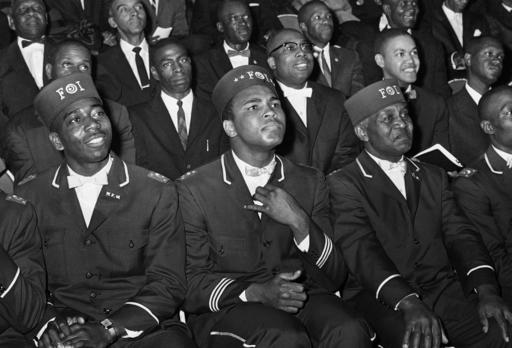
In this Feb. 28, 1966 file photo, Muhammad Ali listens to Elijah Muhammad as he speaks to other black Muslims in Chicago. Two days after the 1964 fight with Sonny Liston, Cassius Clay announced he was a member of the Nation of Islam and was changing his name to Cassius X. He would later become Muhammad Ali as he broke away from Malcom X and aligned himself with the sect’s leader, Elijiah Muhammad. “What is all the commotion about?” he asked. “Nobody asks other people about their religion. But now that I’m the champion I am the king so it seems the world is all shook up about what I believe.” (AP Photo/Paul Cannon)
LOUISVILLE, Ky. (AP) — For years after boxing great Cassius Clay adopted the Muslim faith and changed his name, his hometown paper refused to call him Muhammad Ali.
Fifty years later, The Courier-Journal, Louisville’s daily paper, apologized for continuing to call him Cassius Clay after he changed it in 1964. It did not consistently refer to him as Muhammad Ali until 1970.
Ali died June 3 and an estimated 100,000 people lined the streets of Louisville to say goodbye to the city’s most celebrated son during his funeral Friday.
Executive Editor Neil Budde wrote Monday’s editorial that chronicled how the paper for years either ignored Ali’s preferred name or outright mocked it.
“We won’t even try to speculate what the motives of the editors in that era were,” he wrote. “The CJ was certainly an early champion of civil rights and desegregation. Yet we took what in today’s light is an oddly hostile approach on the specific issue of Ali’s name, which did little to help race relations in a turbulent time.
The paper was among many newspapers and magazines across the country that continued to call him Cassius Clay for years after he changed his name in keeping with his Islamic faith.
Budde said reporter Joe Gerth researched the newspaper’s history and editors debated the proper way to address it after Ali’s death, as a series of planned memorials and spontaneous celebrations consumed the city for a week. The editors decided to issue a belated apology.
He compared it to the Lexington Herald-Leader’s front-page clarification in 2004, in which the paper apologized for having failed 40 years earlier to properly cover the civil rights movement.
