

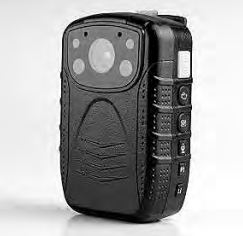
When the mayor of Baltimore City, Stephanie Rawlings-Blake, and Police Commissioner Anthony Batts released a report on ways to reform the Baltimore Police Department (BPD) in the aftermath of two damning videos that surfaced showing Baltimore police officers engaged in seemingly unwarranted violence against citizens, the report included a recommendation to “convene a panel to develop a pathway towards” implementing a body camera program for the BPD.
Body cameras, small cameras worn by police officers for the purpose of recording both video and audio interactions with the public, are believed to have the potential to reduce the incidence of use-of-force by police officers. The report cites a study produced by the Police Foundation, an organization that seeks to use social-scientific research to improve policing practices, which found a 50 percent reduction in use-of-force incidents among Rialto, Calif. police officers equipped with cameras, as compared to a control group of officers not wearing cameras.
That study was designed to test the effect of an officer’s awareness that she was being recorded on her likelihood to use force. It did not investigate the question of whether citizens were more likely to engage in behavior that required a use-of-force response from officers if those citizens knew they were being recorded, but the study does note that in the case of the officers equipped with cameras, physical contact was initiated by citizens in all of the use-of-force incidents, whereas in the 17 use-of-force incidents in which control group officers were involved, physical contact was initiated by police in four of those instances.
For the last 18 months, the police department in Laurel, Md. (LPD) has equipped its officers with body cameras worn on a sunglass or headband mounts, recording interactions with the public from the officer’s point of view. According to Deputy Chief James Brooks of the LPD, the cameras are always on and officers press the record button during any citizen contact in the public domain and let citizens know they are being recorded with both video and audio.
If the officer is in an area where a person has a reasonable expectation of privacy, such as a home or a hospital room, the officer only records if consent is given. Once the officer hits record, the camera saves the previous 30 seconds of video (no audio is saved on this portion of the recording), and the camera then records video and audio until the officer subsequently turns off the recording.
Brooks says that though some officers were apprehensive at first about the new equipment, the value of the cameras for the purpose of documenting and collecting evidence, training and even resolving complaint issues (officers can now sit down with complainants and explain why they acted as they did in a given situation with reference to the recorded interaction), has ultimately won the day. Since implementing the body camera program, Brooks says the LPD has seen an approximately 30 percent decline in use-of-force incidents.
“ kind of just puts everybody on the same playing field,” said Brooks. “It’s a document of what actually occurred. It’s going to change behavior in both the citizen in some cases, and the officers in some cases, so I think it’s a win-win.”
For David Rocah, a senior staff attorney for the American Civil Liberties Union, Maryland, police-worn body cameras can provide critical evidence for determining whether any misconduct occurred during a police-citizen interaction, but they are limited to documenting single instances and cannot address broader cultural issues within a police department.
“It’s critical that in our focus on police body cameras, we don’t lose sight of their limitations, and don’t lose sight of the importance of data collection and meaningful data analysis, and accountability by police departments—something that Baltimore is currently not really doing and not good at. That’s a critical defect,” said Rocah in a conversation with the AFRO.
While Rocah believes that if a body camera program is implemented, all interactions between the public and police in which an officer is exercising her police authority should be required to be recorded, he says that policy protections must be in place in order to prevent the cameras from turning into a dangerous surveillance tool, used to compile information on all persons in Baltimore or all persons in certain communities.
There are also important questions about how long recorded interactions should be stored, and while he understands law enforcement’s desire to keep recordings for the entire statutory period of limitations for filing a complaint against an officer, that period is three years, an amount of time over which a massive amount of data could be collected and saved.
“I think if the data is going to be kept for that long, then there has to be, preferably legislative but at the very least policy, prohibitions on accessing that data for any purpose other than to assess whether misconduct occurred in a particular incident, or when the video itself is evidence to be used in a criminal case against a member of the public,” said Rocah.
In a letter dated March 25, Sen. Brian Frosh and Del. Joseph Vallario Jr., made a request of the Governor’s Office of Crime Control and Prevention to form a work group to consider how the state might move forward on the use of body cameras. According to Kisha Brown, director of legislative affairs and of civil rights for the Maryland Attorney General, the work group will consist of persons in the law enforcement, legislative and civil rights advocacy arenas.
“I’m hoping that bringing all these stakeholders together will provide for a more in-depth and knowledgeable discussion around body cameras,” said Brown.
The work group is set to have its first meeting on Oct. 23, and is expected to make its recommendations on the implementation of body cameras by Dec. 1 to both chairs of the Judiciary Committee. The work group’s findings will set the stage for whether the General Assembly might act and how long such action may take to materialize.
“Depending on the complexity and the parameters of the proposed language, something like this could take a year, or it could take multiple sessions,” said Brown. “But I think there is energy around doing something around this issue, not only in Maryland but around the country.”
ralejandro@afro.com
