

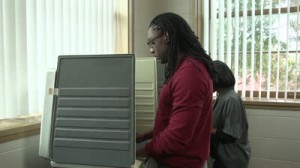
Former felons can vote as long as their sentence is completed.
Baltimore lawmakers have succeeded in guiding expanded voting rights for felons through the General Assembly. While it is not clear whether Gov. Larry Hogan (R) will sign the bill into law, supporters believe they have the votes to override a veto.
Sen. Joan Conway (D-Baltimore City), chair of the Senate Education, Health, and Environmental Affairs Committee, and freshman delegate Cory McCray (D-Baltimore City) each introduced bills in their respective chambers to expand the franchise to felons immediately upon release from prison, regardless of whether the person in question was still on parole or probation.
Back in 2007, former Gov. Martin O’Malley (D) restored the franchise rights of felons, but only upon completion of parole and probation. Advocates argued that the 2007 law did not go far enough since it preserved a level of alienation from society for convicted felons that could work to sabotage their efforts at reintegration.
“One of the things that sometimes gets left out of the conversation is those community members that are in our communities, they have children too, they have children that go to school too, they’re concerned about centers closing too, they’re concerned about the hospitals that their grandparents get treated in. And what does that revolve around? It revolves around politics. So when we’re choosing our state, local, municipal leaders, we have to make sure that they have a seat at the table, because they are home, they are right in our communities, they are right next door to us,” said McCray.
The original House and Senate versions of the bills included language imposing requirements on the Maryland Department of Public Safety and Correctional Services to provide felons with information related to their restored franchise rights prior to release. This language which was mostly stripped out through the amendment process.
Advocates seemed unconcerned about those changes, however, arguing that restoring the right to vote was all that ultimately mattered. “ is going to change not only my life, but a lot of other people’s as well as generations to come,” said advocate, community organizer, and former felon Perry Hopkins. “I’m fully a citizen now.”
In 2016, Hopkins will step into a voting both for the first time in his life. “I remember the signs that said, ‘pull lever 6,’ . . . I’ve never even seen a lever,” said Hopkins. “They say you do it by now so I’m really looking forward to this experience.”
The effort to expand felon voting rights was something of an oddity among the criminal justice related bills under consideration in the 2015 legislative session. The bill passed despite it being a first-time effort, and was met with limited opposition testimony in the House hearing, according to McCray, and none when it was heard by Conway’s committee in the Senate.
Conway says she is not sure whether Hogan will ultimately sign the bill into law, noting that the governor is not a fan of the effort, but believes that in any case there are enough votes in the General Assembly to override a veto.
For Conway, the bill represents an important step in helping felons who are released from prison reintegrate into their communities. “If you’re not invested, and you can’t participate in the system, and you still live in our communities, sometimes you just don’t do the things that you need to do to improve your community because you feel that you’re not a part of it,” said Conway.
If Hogan vetoes the measure, legislators will have to wait until next January, when the General Assembly will reconvene for the 2016 legislative session, to attempt to override the veto.
ralejandro@afro.com
