

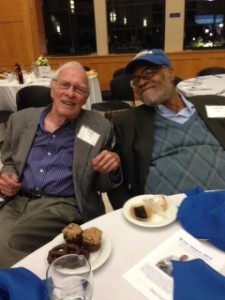
Former Jesuit priest, Frank Fischer and Ralph Moore, at a Oct. 25 event honoring fellow alum, Van Brooks, class of 2006
St. Ignatius of Loyola in 1522, to begin his conversion experience from soldier to religious leader, laid down his sword before a statue of Our Lady of Montserrat, the Black Madonna of Spain. Centuries later, Loyola Blakefield, the school in Towson bearing his name, will hold an exciting reunion of at least 100 African-American alumni, Nov. 1, in Knott Hall on campus.
Since its founding in 1852, over 400 African Americans have graduated from Loyola Blakefield starting with attorney Ken Montague in 1960. Three African-American members of the Baltimore City Council are also graduates of then Loyola High School: Carl Stokes, ’68, William (Pete) Welch, ’72 and Bill Henry II, ’86. Among the Black graduates from the high school (which now includes a middle school) are a number of attorneys, a judge of the D.C. Superior Court, a linebacker with the Pittsburgh Steelers, college professors, businessmen, ministers, government administrators and a social justice advocate or two.
A diversity fund, named for Frank P. Fischer, formerly a Jesuit priest, who was the driving force for more fully integrating the school racially and economically, has been established to support more Black students.
In the early 1960s, after being inspired by Martin Luther King at the March on Washington, Fischer, who was White, created a recruitment program, called the Higher Achievement Program, and raised money from his fellow Jesuits and Jerold Hoffberger, then owner of the Baltimore Orioles. Funds for the Carroll Scholarship were realized from the sale of property the Jesuits owned in Prince George’s County, where they once held slaves.
The account of how then Loyola High School became integrated is a fascinating story. For 25 years, after the Jesuits received a large gift which allowed them to move from downtown on Calvert Street to Towson, they did not admit “colored boys” as a condition of the donation. They were able to buy farmland on Charles Street in Baltimore County, which they renamed Blakefield. The Jesuits ended their commitment to segregation by admitting Montague in 1956. He later served in the Maryland House of Delegates and as Secretary of Juvenile Services in the Ehrlich administration.
The Jesuits atoned for their unfortunate acceptance of racial segregation by creating a scholarship fund in the mid-1960s to attract gifted, poor African-American students to the Loyola High School student body.
So as a result of their redemptive move, many of those students will gather, 10 a.m., Nov. 1, with a welcome from Anthony Day, Loyola president, a reunion program and a talk about the Frank P. Fischer Diversity Fund Endowment, which (through contributions from the African American Alumni) will raise at least $300,000 in scholarship funds over the next five years.
The program will be followed at noon by a football game – Loyola against St. Mary’s Riken of Southern Maryland. The two coaches of the team, Brant Hall, head coach and Bernie Bowers, assistant coach and diversity director) are both African-American graduates of Loyola Blakefield.
For more information, call Loyola Blakefield 410-823-0601 or contact Ralph Moore: vpcs@yahoo.com or Carl Stokes: carl2411@aol.com.
Anyone wanting to contribute to the Fischer Diversity Fund can find instructions on loyolablakefield.org.
