


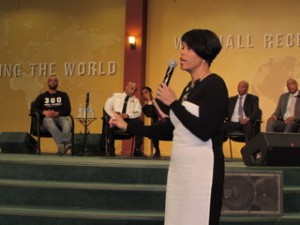
Mayor Stephanie Rawlings-Blake called for continued conversation and stressed that collaboration was key to addressing the violence that affects Baltimore City. (Photo by Roberto Alejandro)
Mayor Stephanie Rawlings-Blake stressed the need for collaboration and continued conversation at the first forum on the mayor’s call to action to end African-American homicides.
Held at the Rev. Dr. Jamal Bryant’s Empowerment Temple on March 24, the forum consisted of a panel featuring representatives from law enforcement, city government, mentoring and community organizations, as well as public educators. The discussion focused predominantly on what can be done for youth, as most of the panel consisted of youth advocates and educators, while the questions posed by community members raised the issue of the need to provide services for adults that could ripple into improved well-being for the city’s youth.
“We know that none of us has all the answers,” said Rawlings-Blake as she opened the forum, “but I firmly believe that by working together we can make a real difference in our community.”
The mayor stressed that it was the first in a continuing discussion about how to reduce homicides in Baltimore City, the overwhelming majority (90 percent) of which claim Black lives.
“It truly, truly devastates me, when I think about the violence in our city, that it continues to disproportionately impact our African American men,” said Rawlings-Blake.
Baltimore City Councilman Brandon Scott spoke about the need for Black people to combat the media images which send a message to too many young men that violence is an inherent part of their identity.
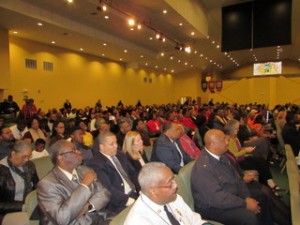
Community members who attended the first forum on Mayor Stephanie Rawlings-Blake’s call to action to end African American homicides. (Photo by Roberto Alejandro)
“I know that most Black men don’t live that life,” said Scott of the media portrayal of Black men as thugs and criminals, “but these children that I talk to every day, every day, they think that I am the exception to the rule. They think that everyone that looks like them has to be violent, has to sell drugs, has to play basketball—and we all know Councilman Scott loves sports, but what we have to do is realize that that is an issue that we don’t talk about: who is in control of these images.”
Munir Bahar, a health advocate who works with young people through his COR Health Institute and engages the problem of street violence through his 300 Men March Movement (co-founded with Scott), challenged the idea that new or different ideas are needed to combat the violence that afflicts Baltimore.
“We keep how is this different? Nothing is different. We don’t need anything different. We need consistency . . . we need dedication. Our young people need dedicated warriors,” said Bahar, who added that he just wanted “an end to the genocide, I just want to be a part of .”
During the questions and comments from community members, one man asked what services there were for parents who wanted to read with their kids, but themselves lacked the requisite educational background to be more engaged in their children’s education.
Deputy chief academic officer for the Baltimore City Public School System Dr. Theodore Thompson spoke about the wrap-around adult education pathways and services the school system has worked to provide students who have aged out of the public schools, some of whom are parents themselves. Baltimore has many resources, said Thompson, but better coordination between the different service providers and the school system is needed to take full advantage of this critical infrastructure.
Joe Jones, founder of the Center for Urban Families, a non-profit that seeks to connect families with work and support men in their role as fathers, said that his organization also provides support for parents, particularly in the arena of adult literacy.
This back and forth on services for adults that can have a ripple effect on the lives of youth was a theme that emerged from the public discussion at the forum, with one man standing up and saying, “I would like to challenge the panel: start doing more for the convicted felons because these kids . . . they’re listening to them.”
“I’m a convicted felon,” he continued, “I once lived that reckless life. I received a 25 year sentence for a homicide. I just received my bachelor’s degree. . . . We have to reach out and help because they’re able to slow some of this stuff down that goes on in the street, because they’re the pillars.”
In her concluding remarks, Rawlings-Blake again stressed that the night’s forum was a beginning of the conversation. The next forum will be held, 11 a.m., April 24, at the St. Paul Baptist Church.
ralejandro@afro.com