


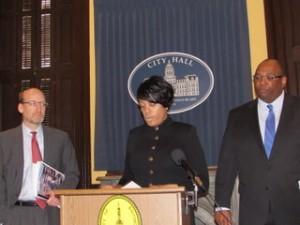
Budget Chief Andrew Kleine, left, stands with Mayor Stephanie Rawlings-Blake and Finance Director Henry Raymond. The Mayor previewed Baltimore’s fiscal year 2016 budget for the press on April 1. (Photo by Roberto Alejandro)
Mayor Stephanie Rawlings-Blake said Baltimore’s fiscal year 2016 budget will continue to promote job growth and efficiency in government.
“The fiscal policies put forward by this administration has laid the foundation for the creation of 12,000 new jobs, and a one-third reduction in the city’s unemployment rate since I took office,” said Rawlings-Blake.
The new budget will not only help continue that progress on employment, said the mayor, but also continue to encourage greater efficiency in the operation of city agencies.
“As we sought to get Baltimore growing again, I made it clear to agency heads that they would have to learn to do even more with less,” she said. “Everyone was put on notice that they would have to find reforms and find efficiencies within their budgets to better meet the needs of our residents without raising taxes or fees…The city’s workforce is now the smallest on record in a generation, demonstrating that agency leaders got the message I was sending from City Hall.”
According to Andrew Kleine, budget chief for the city of Baltimore, the fiscal 2015 property tax rate of $2.248 on every $100 of assessed value ($2.13 for owner-occupied properties) will remain the same under the new budget, though the city remains on track—and slightly ahead of schedule—to achieve the mayor’s goal, announced back in 2011, of reducing the property tax rate by $0.20 by 2020.
“The casino revenue has not been as strong, you all know that, so more of the costs of the tax relief is having to be absorbed elsewhere,” Kleine said. “We’re confident we will hit the 2020 , but this year our current estimate is that that rate will be the same as in ’15.”
ralejandro@afro.com