


The 29-hour shuttering of the Metrorail system on March 16 and March 17 created no shortage anxiety among some of its passengers who were forced to make other travel plans.
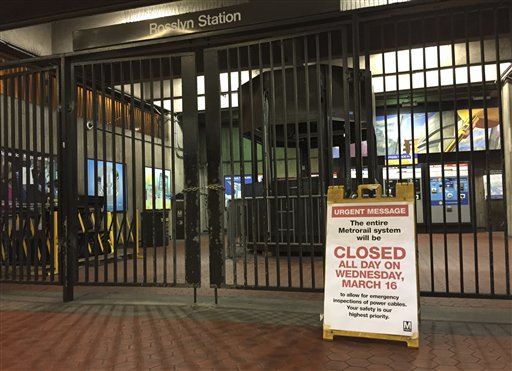
A sign at the Rosslyn, Va., Metro station notifies riders that the system is closed for emergency inspection Wednesday, March 16, 2016. An unprecedented safety shutdown of the Metro subway system inconvenienced hundreds of thousands of people in and around the nation’s capital on Wednesday. Federal workers telecommuted or took the day off, children missed school and countless others woke up early to take bus after bus, hail pricey taxis or slog through traffic. (AP Photo/Jessica Gresko)
At the Addison Road-Seat Pleasant Metro Station on the Blue and Silver Lines on March 15, people chatted at the bus stations about the Washington Metropolitan Transit Authority’s system-wide shutdown of its subway system, Metrorail.
“This is very frustrating,” said Rose Field, a D.C. government employee. “I just started a new job two weeks ago and I have already been late because of Metrorail. My employer doesn’t want to hear that I am late to work because of Metro.”
Fields said she would have to resort to alternative arrangements.
“Unfortunately I will have to drive to work,” she said. “I will have to get gas to drive into downtown D.C. and pay $30 to park downtown.”
While Metro stations offered free parking on March 16 for those traveling by bus, that didn’t help Fields, who said that catching the series of buses needed to get to downtown Washington “wasn’t worth the time.”
Christina Horton said the March 16 shutdown was “a real inconvenience.”
“I think the decision to close the Metro train system was horrible,” Horton said. “I will have to travel to Reagan National Airport to get to work and in order to do that, I have to take five buses from here. That means to catch my bus I will have to leave two hours earlier than usual.”
Robert and Sylvia Currie might have taken the shutdown with a grain of salt. As private-industry employees, the couple had agreed to telecommute as soon as the announcement of the shutdown was made March 15. Their anxiety, however, reached a feverish pitch when they realized their five children would still have to attend school.
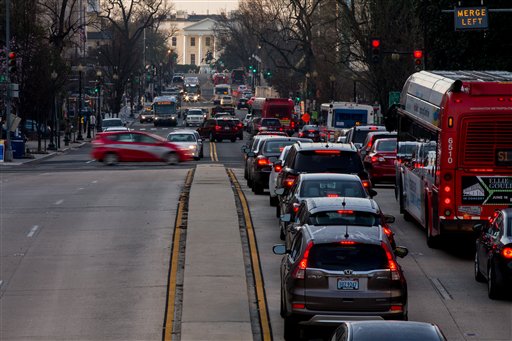
The White House is visible as morning traffic builds along 16th Street Northwest, in Washington, Wednesday, March 16, 2016. The Metro subway system that serves the nation’s capital and its Virginia and Maryland suburbs shut down for a full-day for an emergency safety inspection of its third-rail power cables. Making for unusual commute, as the lack of service is forcing some people on the roads, while others are staying home or teleworking. (AP Photo/Andrew Harnik)
Residents of Ward 7, the Curries said the maneuvering of children between three different public schools, as well as the University of the District of Columbia, became too cumbersome; they abandoned their attempt in mid-travel.
“The unfortunate thing about this is that we could have made better arrangements for the children, but Metrorail does not extend into every neighborhood—nor do the buses,” said Robert Currie. “But when the entire world seemed like it was trying to get into the city, even side streets and shortcuts became backed up. Once the alleyways off of East Capital became full, we had to give up.”
The Curries were among thousands of District residents whose daily commute requires using the subway or walking through what can be potentially hazardous areas, including new developments built in Ward 8 along the Suitland Parkway.
Donya Eckles and her children normally take the Metro to the Anacostia station, after which two members of the family journey up Martin Luther King Jr. Avenue and two others connect to service near the Navy Yard station. From the onset of the shutdown, however, Eckles said she feared other methods of travel would not end well for the kids.
“I can laugh about it now, but it was just too hectic with so many people on the roads and when buses did come, they were packed in like sardines. These are small kids and it is just not a good idea to have them out in crowds of frustrated people trying to get to work,” Eckles said. “My youngest, Tennille, became agitated and needed her asthma inhaler and I knew it was not worth the effort.”
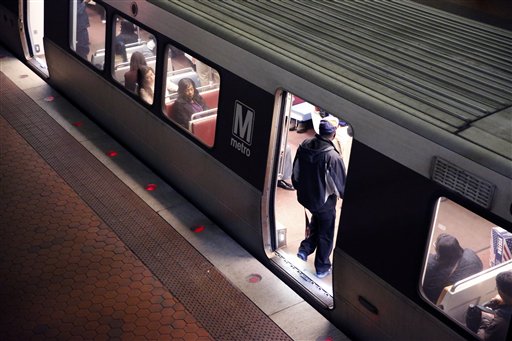
A rider enters a Metro train in the Gallery Place-Chinatown Metro station Tuesday, March 15, 2016 in Washington. The head of the rail system that serves the nation’s capital and its Virginia and Maryland suburbs says the system will shut down for a full day after a fire near one of the system’s tunnels. (AP Photo/Alex Brandon)
Riders take more than 700,000 trips on Metro trains every day as a convenient way to get downtown from Maryland, Virginia and the city’s outer neighborhoods. However, the mid-week shutdown has caused many to re-evaluate their commutes and plan alternatives should the system need to be shut down once again for additional repairs.
“We had to get into the city from Arlington which made us leave around 2 a.m.,” said Rolmud Asad, a Subway sandwich shop owner. “We knew enough to have at least two people find lodging around the corner at a hotel so we could still open on time, but those two had to do all of the work until the rest came. Some stores did not fare so lucky and had to close for the day. All around, that is just bad business for the city.”
However, Marlon Ferrell, a resident of Seat Pleasant, Md., said he was comfortable with the decision to shut down the train system.
“I will take the bus to work if I have to,” Ferrell said. “If that doesn’t work out, I will stay home.”
On March 16, the entrance of the Capitol Heights Station was closed, with a black and gold metal gate in front of it. While the trains were not running, Metro personnel wouldn’t allow people to go into the station even to put more money on their fare cards.
Later that day, Metro General Manager and CEO Paul Wiedefeld and D.C. Council member Jack Evans (D-Ward 2) announced that the Metro would resume full service on March 17. The issues regarding approximately 600 of the system’s third-rail power cables had apparently been resolved.
Wiedefeld’s decision to shut down Metrorail has been criticized primarily because of a lack of notice. Despite the critics, Wiedefeld stands by his decision.
“When I say safety is our highest priority, I mean it,” he said. “That sometimes means making tough, unpopular decisions, and this is one of those times. I fully recognize the hardship this will cause.”
U.S. Sen. Barbara Mikulski (D-Md.) called for an oversight meeting between her senatorial colleagues from the Washington region, Wiedefeld and other leaders responsible for Metro safety in April. Mikulski has been a strong supporter of Metro on Capitol Hill, though she has been known to criticize its shortcomings, particularly relating to its culture of safety.
“The action to shutdown down the Metrorail system was dramatic, drastic and disruptive, but necessary to ensure safety is finally being taken seriously at Metro,” she said.