

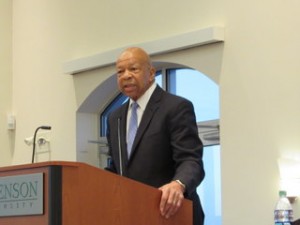
Congressman Elijah Cummings addresses the audience at a recent forum on police-community relations.
The need to reform the Law Enforcement Officers Bill of Right (LEOBR), the importance of filing complaints against officers, and the benefits offered by body-worn cameras all emerged as points of convergence between law enforcement officials and those concerned with protecting citizens from police abuse at a recent forum on community-police relations.
The forum was sponsored by two chapters of the Alpha Kappa Alpha Sorority and held at Stevenson University on Oct. 27. Congressman Elijah Cummings opened the forum with a series of personal stories spanning the community-police relations divide, recounting unjustified police stops on the one hand, the sort of harassment that undermines trust in the police, and the murder of his nephew, a case in which Cummings and his family desire justice but have seen it deferred due to the unwillingness of community members to step forward and cooperate with the police.
“Law enforcement has a major job to do. We have to have police, we have to have them,” said Cummings. “You get robbed and you pick up the phone and call and nobody shows up; or you get to your house, as I’ve done, and see the door broken open, and make a call to the police; you better hope somebody shows up because you better not go in there, because you don’t know who’s there.”
The forum consisted of a panel that included three former and current law enforcement officials, a state’s attorney, a poet and activist who spent 11 years in prison, and a defense attorney. A number of issues were discussed at the forum, including what to do when pulled over by police as well as the ways in which police are supposed to conduct themselves during such stops, but what was most interesting were the points of convergence between the officials, and those on the panel representing the community perspective.
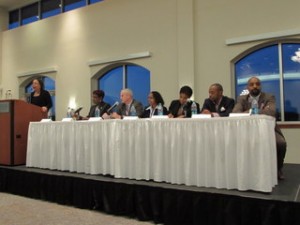
A panel of former and current law enforcement officials, prosecutors, citizens, and defense attorneys at a forum on police-community relations held at Stevenson University.
“Any time that a police officer does something wrong you should file a complaint,” said defense attorney Derrick Hamlin, who said that there are many forms of police misconduct and that if enough complaints are filed against an officer, that officer will eventually be investigated by his department.
“I would echo that,” said former Howard County chief of police William McMahon, who handled the response to the Columbia mall shooting earlier this year. “I didn’t spend 30 years of my life in a profession to be ashamed of it. . . . We do care , we will act on it, sometimes it takes longer than everybody would like.”
McMahon even went as far as to express frustration with the Law Enforcement Officers Bill of Rights, because it limits the ability of police officials to discipline officers as well as do so in what some would consider a more timely manner. Hamlin agreed.
Another point of agreement between those on the law enforcement and community sides of the panel was on the benefit of body-worn cameras. Syeetah Hampton-El, a prosecutor with the State’s Attorney’s office in Baltimore City, compared police body cameras to the dashboard cameras police utilize during traffic stops, and said that body cameras would provide valuable evidence the same way those dash-cams often do.
Hamlin agreed that the cameras are valuable both for protecting citizens, as long as officers are unable to turn them off while engaged in problematic behavior, and in providing evidence, which better allows him to represent his clients.
McMahon referred to body cameras as the future, but warned that they are not a panacea to police-community relations issues, analogizing to the practice of NFL replay, in which the legality of a play is rarely visible from every camera angle on the field but only from certain vantage points. Body cameras, McMahon suggested, are subject to the same limitation, and may not tell as much of the story as one would want in any given situation.
ralejandro@afro.com
