

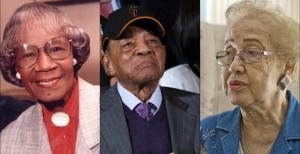
Pioneering politician Shirley Chisholm, Major League Baseball’s Willie Mays, and former NASA mathematician Katherine G. Johnson. (AP and Courtesy Photos)
Pioneering politician Shirley Chisholm is one of three African Americans among the 17 individuals who will receive the Presidential Medal of Freedom during an award ceremony at the White House Nov. 24.
The Medal is the nation’s “highest civilian honor, presented to individuals who have made especially meritorious contributions to the security or national interests of the United States, to world peace, or to cultural or other significant public or private endeavors,” according to the White House.
This year’s recipients are a varied group, ranging from politicians to entertainers, sports players and engineers.
“I look forward to presenting these 17 distinguished Americans with our nation’s highest civilian honor,” President Obama said. “From public servants who helped us meet defining challenges of our time to artists who expanded our imaginations, from leaders who have made our union more perfect to athletes who have inspired millions of fans, these men and women have enriched our lives and helped define our shared experience as Americans.”
Chisholm, who is being awarded posthumously, made history in 1968 by becoming the first African-American woman elected to Congress. She served seven terms in the House of Representatives. Four years later, the Democrat made history again when she became the first major-party African-American woman to run for the U.S. presidency. The fiery lawmaker died in Jan. 1, 2005, at the age of 80 in Ormond Beach, Fla.
Congressional Black Caucus Chairman Rep. G.K. Butterfield offered praise for Chisholm—a founder of the CBC.
“She was known as a champion of minority education, employment opportunities, and was the driving force behind SNAP and WIC,” the North Carolina Democrat said of Chisholm’s contributions in a statement. “Her service in Congress on behalf of the constituents of New York’s 12th Congressional District and her leadership within the CBC made an indelible and lasting impact on our 46 current Members.”
Also among this year’s recipients is Katherine G. Johnson, a former NASA mathematician and a pioneer in the annals of U.S. space history. Johnson began working for the National Advisory Committee for Aeronautics, the predecessor to NASA, in 1953. The agency as specifically looking for African-American women to work as “human computers.” Defying the predetermined role for women—which usually did not include sitting in meetings or asking questions, Johnson soon began to stand out, according to a NASA biography.
“The women did what they were told to do,” Johnson recalled. “They didn’t ask questions or take the task any further. I asked questions; I wanted to know why. They got used to me asking questions and being the only woman there.”
That curiosity led to her further inclusion and then leadership among the agency’s teams. “Johnson’s computations have influenced every major space program from Mercury through the Shuttle program,” according to the White House press release. After she joined NACA, “Johnson exhibited exceptional technical leadership and is known especially for her calculations of the 1961 trajectory for Alan Shepard’s flight (first American in space), the 1962 verification of the first flight calculation made by an electronic computer for John Glenn’s orbit (first American to orbit the earth), and the 1969 Apollo 11 trajectory to the moon. In her later NASA career, Johnson worked on the Space Shuttle program and the Earth Resources Satellite and encouraged students to pursue careers in science and technology fields.”
According to Space Coast Daily, Johnson, now 97, does not travel much from her Newport News, Va. home but hopes to make it to Washington for the ceremony. She will likely be accompanied by her two daughters and six grandchildren.
Rounding out the African Americans included on the list is Willie Mays, one of the first African American players in Major League Baseball. Born May 6, 1931, he began his career at the age of 16 as a member of the Birmingham Barons of the Negro American League. Most of his 22-season MLB career, however, was spent as a center fielder for the New York/San Francisco Giants, whom he joined in 1950. In his debut MLB season, Mays won the Rookie of the Year award. After almost two years in the Army, “The Say Hey Kid” returned to the game to claim the MVP award. And, in 1954 he led the Giants to a surprise victory in the World Series, making “The Catch,” which is considered by many to be the greatest defensive play ever. Mays ended his career, the final two of which was spent with the New York Mets, with 660 home runs, making him the fifth all-time record-holder, and he was inducted into the Baseball Hall of Fame in 1979.
Despite his prowess on the field, some say his best attributes were outside of the arena. “If somebody came up and hit .450, stole 100 bases and performed a miracle in the field every day I’d still look you in the eye and say Willie was better. He could do the five things you have to do to be a superstar: hit, hit with power, run, throw, and field. And he had that other magic ingredient that turns a superstar into a super superstar. He lit up the room. He was a joy to be around,” said Hall of Famer Leo Durocher in a statement on the Hall of Fame website.
Now 84, Mays continues to reside in Atherton, Calif., where he has lived since 1969, according to Palo Alto Online.
