

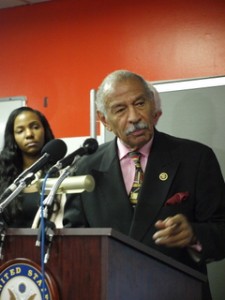
U.S. Rep. John Conyers addresses media about the importance of job training, as recent Project H.O.P.E. graduate, Phyllis Ussery looks on.
The young people trained by Raymond Bell through D.C.’s Project H.O.P.E. are no strangers to the transformative power of proper training. Since 2009, Bell has successfully trained 375, mostly African-American youth, in the IT field, with 315 of them earning employment in their fields and grossing average incomes of $42,000 annually. It was fitting then, for U.S. Rep. John Conyers Jr. (D-Mich.) and Sen. Bernie Sanders (I-Vt.) to announce the introduction of legislation to address youth unemployment through the funding of similar job training centers.
Calling the lack of foundational training a crisis that has contributed to a 27 percent unemployment rate among African Americans youth, Sanders and Conyers associated the lack of work, education, and hope to a slippery slope leading to mischief and prison.
“The No. 1 domestic problem we have in America is our economy and progress has been slowest among America’s youngest workers. Here we have it, this school to prison pipeline,” Conyers said. “You don’t have to be a criminologist to know this is a natural reaction.”
Under the {Employ Young Americans Now Act}, the U.S. Department of Labor (DOL) would provide $4 billion in grants to states and local governments to offer summer and year-round employment opportunities for low-income youth, with an additional $1.5 billion in competitive grants set aside for work-based training.
“It makes more sense to invest in jobs, job training, and education than to build more jails. By investing in programs like Project H.O.P.E, America can stop locking up its young people and give them hope, education, and job training,” Sanders said. “That’s what this legislation does.”
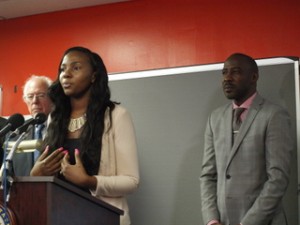
While the correlation between unemployment and crime remain far less definitive than Sanders and Conyers suggest, the success of youth programs that offer access, as well as life skills, business fundamentals, and specialized training, is proven.
In the tradition of powerful grassroots organizing, Bell donned the hats of instructor, recruiter, and counselor, from 2009 to 2013, Bell’s dedication has helped Project H.O.P.E grow from 25 students a year, to approximately 250. In everything, Bell said, is the spirit of hope – Helping Other People Excel.
“These are kids coming from the streets and they are working in big time corporations. We are developing them as professionals – they speak well, they understand how to carry themselves, they write well – that’s what excites me,” Bell said. “We build a community by showing that among our mentors some were homeless or facing real challenges and now they are working at Lockheed or the World Bank. It’s always about how my success can help someone else.”
Bell’s trainees, including Phyllis Ussery, have not only moved into high-yielding careers, but have also come to embody the “Each One, Teach One” mentality that brackets Project H.O.P.E.
“The young people who join Project H.O.P.E are no longer hanging outside doing nothing, they’re too busy planning their futures and improving their lives,” Ussery said. “I hope this legislation passes so that it helps young people view their peers as role models who gained access to the world outside their neighborhoods, and who are always prepared to also help them build successful lives.”
