

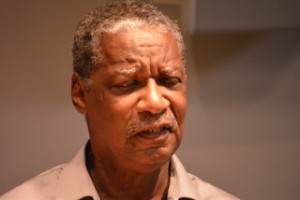
Marshall Eddie Conway recently visited Morgan to talk about his newest book, “Marshall Law.”
The medium-sized crowd was quiet as Marshall Eddie Conway told his story and talked about his newest book, “Marshall Law.” Hosted by Dr. Raymond Winbush, director of Morgan’s Institute for Urban Research, the Nov. 6 forum in the Communications building served as a proper forum for Baltimore’s Black Panther to talk about the radical activism that began with ensuring children went to school with full stomachs.
Conway talked about his early days before the Panthers. A former sergeant in the army, he found himself pondering his responsibilities and felt ready to make a difference after witnessing a horror that left him traumatized.
“One morning, I woke up and I looked at the newspaper that the army put out, Stars and Stripes, and I saw a tank sitting in the middle of Newark, N.J., with a machine gun on top of it, and a little soldier with his hands an inch away from the trigger; and it was a 50-caliber machine gun. I saw that and I had to question myself, ‘What am I doing here? What am I doing in the army? What am I doing with that uniform up there, hanging on my locker? And what is going on in the Black community’? That gun was pointed at 25 to 30 Black women standing on the corner in the middle of a protest! I questioned that and I questioned my role in that.”
That horrid imagery influenced his desire to come back to the United States from Germany.
“I decided it was time to come home to see if I could find a way to help reform what was a problem in America, whatever those problems were. We, as a people, in general weren’t making any progress. We didn’t have the money, the jobs or the political power to do that.”
After much investigation, he discovered that “a tremendous number of Black children were going to school every morning hungry, in America in 1968, in the richest country in the world.”
He said, “I knew then, that I had to do something about it. I found that the Black Panther Party was feeding those children; and contrary to what people believe today, because of Cointelpro, The Black Panther Party was not a nationalist, ultranationalist, militant, radical kind of group; it was a group that believed in self-defense. That’s how it was created, that was the initial name: Black Panther Party of Self Defense.”
After years of watching “organizers get shot down in the street, churches get blown up, dogs being sicked on people and children being hosed across the street,” the Black Panther Party formed with the attitude that “we’re organized, but we are not going to let you sic you dogs on us; we’re not going to let you blow up our churches without a fight; we’re not going to let you hose us down in the street. So we’re going to be able to defend ourselves and we demand the right to do that.”
Conway said it was only when “we decided that we were going to exercise that right according to the constitution, that all of a sudden the laws got changed. ‘You can’t have guns anymore; you can do this, you can’t do that, it’s wrong.’ So it was us deciding that we wanted to exercise our rights as human beings in America on the planet to protect ourselves that created the first problem.”
But there was a second problem. “It was us feeding children; it became clear that us feeding the children, us setting up breakfast programs and opening the doors and having 300 hungry children come in, in the various cities represented a public relations embarrassment to America,” Conway said.
For 43 years and 11 months, Conway was a political prisoner as a result of FBI director, J. Edgar Hoover’s disdain for all things related to the Black Panther Party. He was falsely accused of a crime he did not commit. Of his transition, he says, “The world did change, which is horrible, to be quite honest, but I never kind of like, lost touch. I organized the whole time I was in prison; I kind of kept up with stuff.”
He did admit it took him a few days to adjust.
“You know; just the shock from being in the cell to being in the world. I think I adjusted fairly easy because I always kept abreast of what was going on and I had always worked with young people,” he said.
“The secret about working with young people is that they make you aware of the changes. You pull them up and tell them, ‘That ain’t right,’ and they’ll tell you why it is and what you should be doing.”
Y3thomas@gmail.com
